
Are you curious about the exact height of a professional volleyball net? Whether you’re playing, coaching, or just a fan of the game, knowing the net’s official height can change how you see every serve, spike, and block.
The net isn’t just a barrier—it’s the key that shapes the entire flow of the match. You’ll discover the precise measurements that separate men’s and women’s nets, why those differences matter, and how understanding these details can improve your game or simply deepen your appreciation of volleyball.
Ready to raise your volleyball knowledge to the next level? Let’s dive in!

Credit: www.dimensions.com
Net Height Standards
The height of a professional volleyball net is a critical standard in the sport. It defines the challenge for players on both sides. The net height varies depending on the level and category of play. These variations ensure fair competition and suit players’ physical abilities. Understanding the official net height standards helps players, coaches, and fans appreciate the game better.
Men’s Net Height
For professional men’s volleyball, the net height is set at 2.43 meters (7 feet 11 5/8 inches). This height creates a tough barrier for male athletes to spike and block the ball. It demands good jumping skills and timing. This standard is used in indoor and most professional outdoor competitions.
Women’s Net Height
The official net height for women’s volleyball is 2.24 meters (7 feet 4 1/8 inches). It is lower than the men’s net to match average height and reach differences. Female players use this height in all professional indoor games and many outdoor matches. The height provides a balanced playing field for women’s competitions.
Youth And Junior Levels
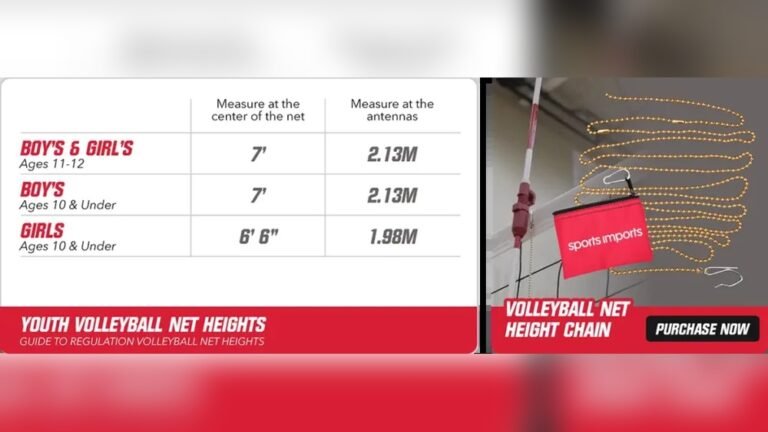
Youth and junior volleyball players use lower net heights. These heights vary by age and skill level. For example, boys under 14 often play with nets around 2.13 meters (7 feet). Girls in the same age group may use nets near 2.10 meters (6 feet 11 inches). Lower nets help young players develop skills without facing too much physical challenge.
Credit: www.ebay.com
Court Dimensions
The dimensions of a volleyball court are critical for fair play and proper game flow. Different types of volleyball have distinct court sizes and net placements. Understanding these court dimensions helps players and organizers set up the game correctly.
Below, we detail the standard sizes for indoor and beach volleyball courts along with the rules for net placement.
Indoor Court Size
An official indoor volleyball court measures 18 meters long and 9 meters wide. The court is divided into two equal halves by the net. Each half is 9 meters by 9 meters. The boundary lines must be 5 centimeters wide and clearly marked. The playing surface should be flat and free of obstacles.
Beach Court Size
A professional beach volleyball court is smaller than an indoor court. It measures 16 meters long and 8 meters wide. Like the indoor court, it is split into two halves by the net. The sand surface must be level and soft enough for safe play. Boundary lines are usually made of tape and must be visible.
Net Placement Rules
The net is placed at the center of the court, dividing it into two equal sides. For men’s professional volleyball, the net height is set at 2.43 meters. For women, the net height is 2.24 meters. The net must be taut and extend 1 meter beyond the sidelines on each side. Proper net height and placement ensure fair competition and safety.
Official Regulations
The height of a professional volleyball net follows strict official regulations. These rules ensure fair play and consistency across all competitions. Different organizations set these standards for indoor and beach volleyball. Understanding these regulations helps players and coaches prepare properly.
International Volleyball Federation Rules
The International Volleyball Federation, known as FIVB, sets global standards. For men’s volleyball, the net height is 2.43 meters (7 feet 11 5/8 inches). For women’s volleyball, it is 2.24 meters (7 feet 4 1/8 inches). These heights apply to both indoor and beach volleyball with minor adjustments.
FIVB rules also specify net width and antenna placement. The net must be 9.5 to 10 meters long and 1 meter wide. Antennas extend 80 cm above the net on each side.
Olympic Standards
The Olympic Games follow FIVB regulations strictly. All volleyball courts used in the Olympics must meet the exact net height. This ensures all teams compete under the same conditions worldwide.
Olympic volleyball nets must be professionally installed and maintained. Officials check the net height before every match. These measures guarantee fairness and accuracy in competition.
National Governing Bodies
Each country has its own volleyball governing body. These organizations adopt FIVB rules but may adjust standards for local leagues. Net height usually remains the same for professional play.
Some national bodies add rules for youth or amateur games. They often lower net heights to suit younger players. This promotes skill development and safety.
Variations By Volleyball Type
The height of a professional volleyball net varies depending on the type of volleyball being played. Different volleyball styles have specific net height rules to suit players’ needs and the playing environment. Understanding these differences helps players prepare for competitions and enjoy the sport safely.
Indoor Volleyball
Indoor volleyball has strict net height rules set by international bodies. For men, the net height is 2.43 meters (7 feet 11 5/8 inches). Women play with a net height of 2.24 meters (7 feet 4 1/8 inches). These heights ensure fair play and match the physical abilities of players. The indoor court and controlled conditions allow for consistent net setup.
Beach Volleyball
Beach volleyball uses slightly different net heights than indoor volleyball. The men’s net height remains 2.43 meters. Women’s nets are also set at 2.24 meters. Outdoor conditions like wind and sand affect gameplay, but the net height stays the same as indoor volleyball. The net is designed to withstand weather and outdoor use.
Coed And Recreational Play
Coed and recreational volleyball often adjust net heights for mixed groups. Some leagues set the net at a middle height around 2.35 meters to accommodate all players. Recreational play prioritizes fun and safety over strict rules. This flexibility helps beginners and casual players enjoy volleyball without worry about official net heights.
Measuring And Installing Nets
Measuring and installing a professional volleyball net requires precision. The net height must follow official standards. Proper setup ensures fair play and safety. Careful measurement and installation improve game quality and player experience.
Tools For Accurate Measurement
Use a reliable tape measure for exact height. A level helps check horizontal alignment. Mark the posts clearly before attaching the net. A measuring pole with height markings works well too. Accurate tools prevent errors in net height.
Proper Net Tension
Keep the net tight but not overly stretched. Correct tension prevents sagging during play. Use adjustable straps or ropes to secure the net. Check tension regularly to maintain consistency. Balanced tension improves ball rebound and gameplay.
Common Installation Mistakes
Incorrect height is the most frequent error. Avoid uneven post placement or loose anchors. Do not overtighten the net, causing damage. Forgetting to check net tension during play is risky. Consistent inspection avoids these common mistakes.
Impact On Gameplay
The height of a professional volleyball net greatly influences how the game unfolds. It sets a clear barrier that challenges players to jump, block, and spike effectively. This height affects every move on the court, from offense to defense.
Players must adjust their skills and timing to match the net’s height. Teams change their tactics to use the net advantageously. Training programs also evolve to prepare athletes for these demands.
Effect On Player Performance
The net height demands strong vertical jumps. Taller nets require more power and precision. Players need quick reflexes to block or spike over it. It tests agility and coordination under pressure. Performance often improves with focused practice on net skills.
Strategic Adjustments
Teams plan attacks based on net height. Higher nets encourage more powerful spikes. Lower nets allow faster, trickier plays. Defenders position themselves to counter expected moves. Coaches design plays that exploit opponents’ weaknesses related to net height.
Training Considerations
Training focuses on building jump strength and timing. Drills simulate game scenarios with net challenges. Athletes practice hitting, blocking, and serving at regulation height. Conditioning programs target muscles used for vertical movement. Consistent practice helps players adapt to net demands.
Future Trends
Changes in volleyball net height may adapt to player age and skill levels worldwide. Adjustments aim to keep the sport fair and enjoyable for all. Future trends could see more flexible standards for different competitions and player groups.
The height of professional volleyball nets has stayed mostly the same for decades. Yet, changes are coming. These changes aim to make volleyball more inclusive and exciting. Advances in technology and shifts in player demographics push these trends forward.
Smaller players and youth athletes gain more focus. Net designs are evolving to suit different levels of play. Rule updates may adjust net height to keep the sport fair and fun.
Adjustments For Different Age Groups
Net heights vary by age and skill. Future trends suggest more precise adjustments. Younger players will use lower nets to improve skills and confidence. Senior players might see nets set at heights that reduce injury risk. These changes help players enjoy the game longer.
Innovations In Net Design
New materials make nets lighter and stronger. Some nets will have flexible heights with easy adjustment systems. Smart nets could track ball hits and provide instant feedback. These innovations will enhance training and match experiences.
Potential Rule Changes
Rule makers consider changes to net height rules. These may allow more variety in net heights during tournaments. Changes will aim to balance competitiveness and player safety. Such rules could open volleyball to more diverse player groups.
Credit: www.homedepot.com
Frequently Asked Questions
What Is The Height Of A Pro Volleyball Net?
The professional volleyball net height is 2. 43 meters (7 feet 11 5/8 inches) for men and 2. 24 meters (7 feet 4 1/8 inches) for women.
Is Volleyball Net Height Different For Pros?
Yes, professional volleyball nets have set heights: 2. 43 meters for men and 2. 24 meters for women. These standards ensure consistent play.
Is Men’s Volleyball Net Higher Than Women’s?
Yes, the men’s volleyball net is higher. It stands at 2. 43 meters (7 feet 11 5/8 inches). The women’s net height is 2. 24 meters (7 feet 4 1/8 inches). This difference follows official volleyball regulations worldwide.
Is The Volleyball Net 3 Feet High?
A standard volleyball net is not 3 feet high. It measures 7 feet 11 5/8 inches for men and 7 feet 4 1/8 inches for women.
Conclusion
Knowing the professional volleyball net height helps players and fans understand the sport better. Men’s nets stand at 2. 43 meters, while women’s nets are 2. 24 meters high. These measurements create fair play and challenge athletes’ skills. Whether playing indoors or on the beach, following these rules keeps the game consistent worldwide.
Remembering net height is key for coaches and beginners alike. This simple fact supports fair competition and enjoyable matches for everyone involved.