Are you setting up a volleyball net and wondering just how high it should be? Getting the height right is more important than you might think.
Whether you’re playing a friendly game with friends, coaching youth teams, or competing in official matches, the net height can make all the difference in your game’s flow and fairness. You’ll discover the exact measurements for men’s, women’s, and co-ed volleyball nets.
Plus, you’ll learn why these differences exist and how adjusting the net height properly can improve your playing experience. Keep reading to make sure your volleyball setup is spot on and ready for action!
Credit: volleyball-tips.com
Official Net Heights
The official height of a volleyball net varies by category. These heights are set by international and national volleyball organizations. They ensure fair play and consistent competition. Knowing the exact height helps players train and compete properly. Below are the standard heights for different groups.
Men’s Net Height
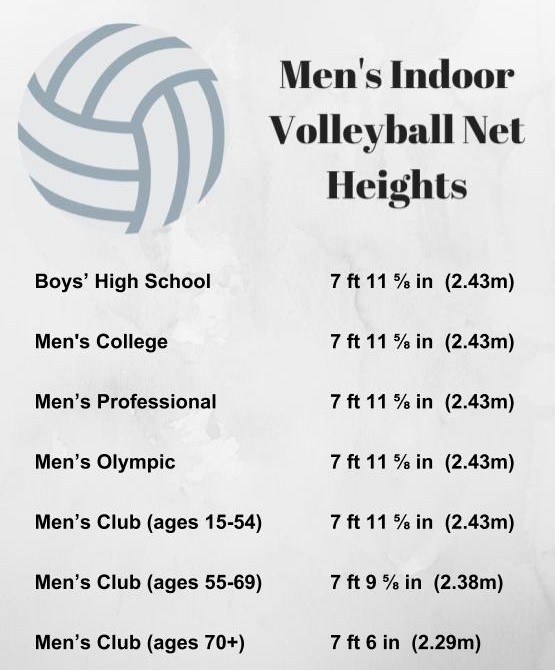
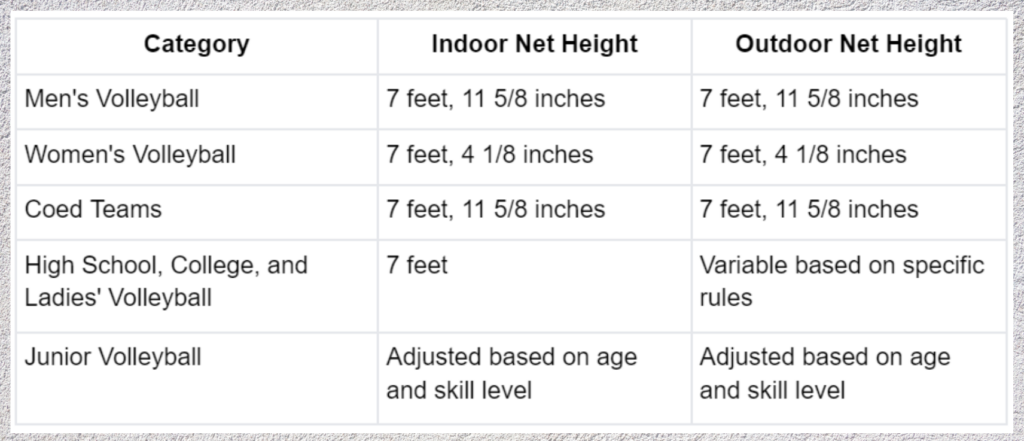
The official net height for men’s volleyball is 2.43 meters. This equals 7 feet 11 and 5/8 inches. This height suits the strength and jumping ability of male athletes. It is used in all major men’s volleyball competitions worldwide.
Women’s Net Height
The women’s net height is set at 2.24 meters. That equals 7 feet 4 and 1/8 inches. This height fits the average reach and play style of female players. It is the standard for women’s volleyball matches internationally.
Co-ed And Recreational Heights
Co-ed and recreational leagues often use different net heights. These can range from 2.20 meters to 2.35 meters. Some leagues lower the net to make play easier and more fun. Recreational players should check local rules for exact net height.
Youth Volleyball Net Sizes
Youth volleyball requires nets set at different heights than adult nets. Correct net height helps young players develop skills properly. It also keeps the game safe and fun. Setting the net too high can discourage beginners. Too low, and it may not challenge players enough.
Many youth leagues follow official guidelines for net heights. These vary by age and sometimes by gender. Knowing the right net height supports fair play and proper technique. Coaches and parents should adjust nets carefully. This ensures every child has a good experience playing volleyball.
Age-based Height Variations
Net height changes as players grow older. For kids under 12, nets are usually around 6 feet 6 inches (1.98 meters). This height suits their reach and jumping ability. Players aged 13 to 14 often use nets set at 7 feet (2.13 meters). Older youth, ages 15 to 18, may use nets near adult heights. Girls’ nets are usually 7 feet 4 inches (2.24 meters). Boys’ nets are set at 7 feet 11 5/8 inches (2.43 meters).
Adjusting Nets For Skill Levels
Skill level affects the best net height for youth players. Beginners benefit from lower nets to build confidence. Intermediate players need moderate heights to improve technique. Advanced players should practice at regulation heights. Flexible net adjustment allows for gradual skill development. Coaches can raise the net as players improve. This approach keeps training effective and engaging.
Indoor Vs Beach Volleyball Nets
Volleyball nets vary between indoor and beach settings. Each type has specific standards for height and court size. Understanding these differences helps players prepare and play better. The net height influences gameplay and player strategy.
Differences In Net Height
Indoor volleyball nets are higher than beach nets. For men, indoor nets stand at 2.43 meters (7 feet 11 5/8 inches). Beach volleyball nets for men are slightly lower, at 2.43 meters as well, but the setup feels different due to the environment. Women’s indoor nets are set at 2.24 meters (7 feet 4 1/8 inches). Women’s beach nets match this height too. Youth and recreational leagues often use lower nets to suit skill levels.
Court Dimensions Impact
Indoor volleyball courts measure 18 by 9 meters. The hard surface allows quick movements and jumps. Beach volleyball courts are smaller, 16 by 8 meters, with sand slowing players down. The smaller court size and softer surface affect net tension and height perception. The environment changes how players approach the net for attacks and blocks.
Credit: sterlingvolleyball.com
Setting Up The Net
Setting up the volleyball net correctly is key to a fair and fun game. The net height must match official standards. Proper setup ensures the net stays tight and stable during play. This section explains how to install the net and avoid common errors.
Proper Installation Tips
Choose a flat surface for the court. Attach the net to sturdy poles. Make sure the poles are vertical and fixed firmly in the ground. Stretch the net tight from one pole to the other. Use the tension ropes or straps to keep the net taut. Check the net height with a measuring tape. For men’s games, set it at 2.43 meters (7 feet 11 5/8 inches). For women’s games, use 2.24 meters (7 feet 4 1/8 inches). Adjust the net so the top band is exactly at this height. Inspect the net for any tears or damages before playing.
Common Mistakes To Avoid
Do not set the net too low or too high. Avoid loose net tension; it can affect play. Do not install poles on uneven surfaces. Avoid using weak or unstable poles. Do not forget to measure net height before every game. Avoid ignoring wear and tear on the net. Do not place the net off-center between poles. These errors can cause unfair play and safety issues.
Impact Of Net Height On Gameplay
The height of a volleyball net significantly shapes the way the game unfolds. It affects how players move, jump, and strike the ball. Different net heights create different challenges and opportunities for athletes. Understanding this impact helps players and coaches adapt their tactics and skills effectively.
Effect On Player Performance
Taller nets require more jumping and stronger hits. Players develop better timing and power to clear the net or block shots. Shorter nets allow quicker plays and more rallies. Players often find it easier to spike and defend. Adjusting net height can improve specific skills based on player ability and age.
Strategic Considerations
Net height changes team strategies and play styles. Higher nets favor strong attackers and blockers. Teams focus on powerful spikes and solid defense. Lower nets encourage fast sets and quick ball movement. Teams use more feints and placements to confuse opponents. Coaches plan tactics based on net height to gain advantage.
Net Height Regulations By Organizations
Volleyball net height varies across organizations. Each group sets standards for different play levels. These rules ensure fair competition and safety. Understanding these heights helps players and coaches prepare correctly.
Fivb Standards
The International Volleyball Federation (FIVB) sets global rules. For men’s volleyball, the net height is 2.43 meters (7 feet 11 5/8 inches). Women’s net height is 2.24 meters (7 feet 4 1/8 inches). These measurements apply to all official international matches. FIVB also governs beach volleyball net heights. They keep the same height as indoor volleyball for men and women.
Usa Volleyball Rules
USA Volleyball follows FIVB standards for most competitions. Adult men’s nets are 2.43 meters tall. Adult women’s nets measure 2.24 meters. Youth divisions have adjusted net heights. They lower the net based on age groups. This helps young players develop skills safely. Rules may vary slightly for different tournaments.
Local League Variations
Local leagues often change net heights to fit players’ needs. Recreational leagues may use lower nets for beginners. Older men’s leagues sometimes reduce net height. Youth leagues adjust nets for different age groups. These changes make the game more enjoyable. Always check your league’s specific net height before playing.
Customizing Net Height
Customizing the height of a volleyball net helps players practice better and enjoy the game. Adjusting net height suits different training goals and player abilities. It makes playing more fun and effective for everyone involved.
For Training Purposes
Lowering the net helps beginners learn basic skills easily. It allows players to focus on timing and technique without struggling to reach high. Coaches can raise the net gradually as players improve. This method builds confidence and skill step by step.
Higher nets challenge advanced players to improve their jump and attack power. Training with different heights also helps players adapt to real match conditions. Using adjustable nets enhances practice quality and keeps workouts varied.
For Different Skill Levels
Youth and beginner players often use nets set below official heights. This adjustment fits their size and strength, making the game fair and fun. For example, children under 12 may use nets 6 feet or lower.
Intermediate players use nets closer to regulation height to prepare for competition. Experienced players train with official or even higher nets to boost performance. Custom net height meets the needs of all skill levels clearly and effectively.
Tools And Equipment For Net Measurement
Setting the correct height for a volleyball net requires precise measurement. The right tools and equipment ensure the net meets official standards. Using proper devices helps players enjoy fair and consistent play.
Accurate measurement also prevents disputes during matches. It is important for coaches, referees, and players to know how to measure the net height properly. The following sections explain the key tools used for this task.
Measuring Devices
A reliable tape measure is essential for checking net height. It should be long enough to reach from the ground to the top of the net. Some tape measures come with a hook to attach to the net post.
Another useful tool is a net height gauge. This device is designed specifically for volleyball nets. It gives quick and exact readings by resting on the net and measuring from the ground.
A portable laser measuring tool can also be used. It provides precise distance measurements without physical contact. Laser devices are helpful for setting nets on uneven surfaces.
Ensuring Accurate Height
Place the measuring device at the center of the net for the most accurate height. The net should be taut and straight before measuring. Loose or sagging nets can give false readings.
Measure from the playing surface directly to the top edge of the net. Avoid measuring to any part of the netting below the tape or wire. Double-check measurements on both sides of the net post.
Regularly calibrate your measuring tools to maintain accuracy. Use a level surface for measurement when possible. Consistency in measurement ensures the net height follows official volleyball rules.

Credit: www.dimensions.com
Frequently Asked Questions
How High Do You Set A Volleyball Net?
Set the official volleyball net height at 2. 43 meters (7 feet 11 5/8 inches) for men and 2. 24 meters (7 feet 4 1/8 inches) for women. Youth and recreational leagues often use lower nets based on age and skill level.
How High Should A 7th Grade Girl Volleyball Net Be?
A 7th grade girl’s volleyball net should be set at 7 feet 4 1/8 inches (2. 24 meters) high, following official youth standards.
What’s The Average Height Of A Volleyball Net?
The average volleyball net height is 2. 43 meters (7 feet 11 5/8 inches) for men and 2. 24 meters (7 feet 4 1/8 inches) for women. Recreational and youth nets often vary based on age and skill level.
How High Is A D1 Volleyball Net?
A Division 1 men’s volleyball net height is 2. 43 meters (7 feet 11 5/8 inches). For women, it is 2. 24 meters (7 feet 4 1/8 inches). These are the official NCAA net heights for indoor volleyball competition.
Conclusion
Setting the correct volleyball net height matters for fair play. Men’s official net height is 7 feet 11 5/8 inches. Women’s net stands at 7 feet 4 1/8 inches tall. Youth and recreational leagues may use shorter nets. Always measure carefully before starting a game.
The right net height helps improve skills and enjoyment. Remember, a well-set net keeps the game fun and safe for all players.