
Are you curious about the exact size of a volleyball net and how it shapes the game you love? Whether you’re setting up for a friendly match in your backyard or aiming to compete at a higher level, knowing the correct width of a volleyball net is essential.
The net isn’t just a simple divider—it’s the heart of the court, influencing every serve, spike, and block. You’ll discover the official measurements of volleyball nets for different levels of play, why these dimensions matter, and how understanding them can improve your game.
Keep reading to get all the details that will help you master the court and play like a pro!
Volleyball Net Width Standards
The width of a volleyball net follows specific standards set by official sports organizations. These rules ensure fairness and consistency in the game. The net width varies slightly depending on the type of volleyball played. Understanding these standards helps players, coaches, and fans appreciate the game better.
Indoor Net Width
The standard width for an indoor volleyball net is 9.5 to 10 meters (approximately 31 feet). This size fits the official indoor court dimensions perfectly. The net stretches tightly across the center line, dividing the court into two equal halves. This width applies to both men’s and women’s indoor volleyball competitions.
Beach Net Width
Beach volleyball nets are slightly narrower than indoor nets. The official width is usually 8.5 meters (about 28 feet). This size suits the smaller beach volleyball courts. The narrower net helps keep the game fast and exciting. It also fits the outdoor playing environment better than wider nets.
Variations By Competition Level
Net width can vary by competition level and age group. Youth and amateur leagues may use smaller nets to match skill levels and court sizes. Professional and international competitions follow strict official sizes. Always check the specific rules for each tournament or league. This ensures players use the correct net width for their level.
Net Height Measurements
The height of a volleyball net is a key factor in the sport. It affects how players serve, block, and spike the ball. Different groups use different net heights. These measurements follow official rules to keep the game fair and fun.
Net height varies by gender and age. This ensures a balanced challenge for all players. Understanding these heights helps coaches set up courts correctly. It also helps players prepare better for matches.
Men’s Net Height
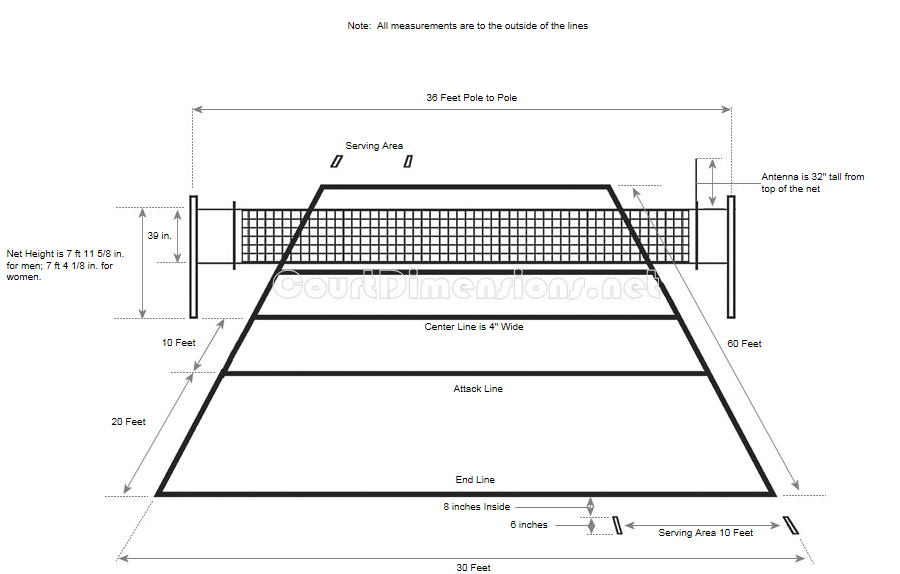
The official net height for men’s volleyball is 7 feet 11 5/8 inches (2.43 meters). This height applies to indoor volleyball competitions worldwide. It challenges male players to use power and skill effectively. Many high school and professional leagues follow this standard.
Women’s Net Height
Women’s volleyball nets are set lower than men’s. The standard height is 7 feet 4 1/8 inches (2.24 meters). This height suits the average female player’s reach and jump. It creates a fair and exciting game environment. Most women’s leagues and tournaments use this measurement.
Youth And Recreational Heights
Youth volleyball nets are shorter to match young players’ abilities. Heights vary by age group, starting as low as 5 feet 6 inches (1.68 meters) for children. Recreational leagues may adjust net height for fun and safety. Lower nets help beginners learn skills confidently.
Volleyball Court Dimensions
The volleyball court has specific dimensions to create a fair playing field.
These measurements ensure players have enough space for movement and action.
Understanding the court layout helps explain the size of the volleyball net.
Court Length And Width
The official volleyball court is 18 meters long and 9 meters wide.
This size applies to both indoor and most competitive matches worldwide.
The rectangular shape balances playing area and allows clear boundaries.
Court Lines And Zones
The court includes several marked lines: end lines, sidelines, and attack lines.
Attack lines are 3 meters from the net on both sides, marking zones.
These zones define where players can move and perform specific actions.
Net Placement On Court
The volleyball net runs across the court width, dividing it into two halves.
The net is exactly 9 meters wide, matching the court’s width.
It is placed at the center line, 9 meters from each end line.
The net height varies: 2.43 meters for men and 2.24 meters for women.

Credit: www.dimensions.com
Materials And Net Construction
The construction and materials of a volleyball net play a key role in its performance. A well-made net ensures clear visibility and proper tension during play. Choosing the right materials affects durability and the overall feel of the game.
Net construction balances strength, flexibility, and weather resistance. Manufacturers use materials designed to last through intense use and outdoor conditions. The net’s thickness and mesh size impact both gameplay and longevity.
Common Net Materials
Most volleyball nets use synthetic fibers like nylon or polyethylene. Nylon is popular for its strength and light weight. Polyethylene resists water and dries quickly, making it ideal for outdoor nets. Some nets include polyester for added durability. These materials provide good tension and minimal stretch.
Net Thickness And Mesh Size
Net thickness varies between 3 to 5 millimeters. Thicker nets offer more durability but may add weight. Mesh size is usually about 10 centimeters square. This size prevents the ball from passing through while maintaining visibility. Proper mesh size helps referees and players follow the ball easily.
Durability And Weather Resistance
Volleyball nets must endure sun, rain, and wind. UV-protected materials prevent fading and weakening. Water-resistant nets avoid mold and mildew growth. Reinforced edges and strong stitching improve net strength. These features keep the net reliable for many seasons of play.
Setting Up A Volleyball Net
Setting up a volleyball net correctly is key for a fair and fun game. The net must be stable, tight, and at the right height. Each step in the setup affects how the game plays out on the court.
Below are the main points to follow when installing a volleyball net. These help ensure the net meets standard size and tension rules.
Pole And Anchor Requirements
The volleyball net needs strong poles on both sides. Poles should be firmly fixed in the ground or on a solid base. Anchors must hold the poles steady to stop any movement during play.
Poles usually stand about 2.55 meters tall for men’s games and 2.43 meters for women’s. Make sure the poles are straight and spaced to match the net width of 9.14 meters (29 feet 6 inches).
Tensioning The Net
Pull the net tight between the poles. This keeps the net from sagging in the middle. Use ropes or cables attached to the top and bottom of the net for proper tension.
Adjust the tension evenly on both sides. The net should be firm but not overly stretched. A loose net disrupts the ball’s bounce and the game flow.
Adjusting For Different Levels
Different players need different net heights. For youth games, the net is lower than for adults. Always check the correct height before setting up.
Indoor and beach volleyball also have slight differences in net height. Adjust the net to fit the rules of your game type. This helps keep the play fair and enjoyable.
Regulation Differences Worldwide
Volleyball net width varies by organization and level of play. Different rules apply worldwide. These differences affect the net size and how the game is played. Understanding these helps players and coaches prepare properly. The next sections explain regulation differences in net width globally.
Fivb Standards
The International Volleyball Federation (FIVB) sets the official net width. For indoor volleyball, the net measures 9.5 meters (31 feet 2 inches) wide. This width suits official international competitions. Beach volleyball nets have the same width but differ in height. FIVB rules ensure uniformity in professional play worldwide.
High School And College Rules
In the United States, high school and college volleyball follow different standards. Most high school nets are 29 feet 6 inches wide. College nets match the FIVB width of 31 feet 2 inches. This slight difference impacts court setup. Schools often adjust net width based on local or state regulations.
Recreational And Amateur Guidelines
Recreational leagues and amateur clubs use flexible net widths. Nets can range between 29 and 32 feet wide. This variation fits smaller or non-standard courts. Many recreational players prefer easier setups over strict regulation sizes. Net width often depends on available space and equipment.
Choosing The Right Net Size
Choosing the right volleyball net size is important for playing the sport correctly. The width of the net must match the type of volleyball being played. Different settings require different net sizes. Using the correct size ensures fair play and improves the overall experience. Below are guidelines for selecting the proper net width for various volleyball activities.
For Indoor Play
Indoor volleyball nets have a standard width of 29 feet 6 inches (9 meters). This size fits official court dimensions perfectly. It ensures players have enough space to move and perform. The net height varies by gender and age, but the width stays consistent. Indoor nets use strong materials to withstand fast and powerful hits.
For Beach Volleyball
Beach volleyball nets are also 29 feet 6 inches (9 meters) wide. This matches the official beach court size. The net is usually lighter and made from weather-resistant materials. The width stays the same to keep the game fair and standardized worldwide. The setup allows for outdoor play on sand with the same space as indoor courts.
For Practice And Training
Practice nets can vary in width depending on the training needs. Some smaller nets help beginners focus on control and precision. Training nets might be narrower to fit smaller spaces or to create specific drills. However, most training nets use the standard 29 feet 6 inches width. Using the official width helps players get used to real game conditions.

Credit: www.youtube.com
Credit: www.courtdimensions.net
Frequently Asked Questions
What Is The Width Of A Volleyball Net?
A standard volleyball net is 29 feet 6 inches (9 meters) wide for both indoor and beach play.
How Wide Is A High School Volleyball Court?
A high school volleyball court is 29. 5 feet wide and 59 feet long. This size meets regulation standards.
What Is A High School Volleyball Net?
A high school volleyball net measures 29 feet 6 inches wide and 7 feet 4 1/8 inches high for men.
What Is The Official Size For High School Volleyball?
The official high school volleyball net measures 29 feet 6 inches wide and stands 7 feet 4 1/8 inches tall for girls.
Conclusion
A standard volleyball net is 29 feet 6 inches wide. This size fits most indoor and beach courts. Knowing the net width helps players practice correctly. It also ensures fair play during matches. Whether playing casually or competitively, the net size stays the same.
Remember, the net width is part of official volleyball rules. Understanding these details makes the game more enjoyable. Keep this in mind next time you set up a volleyball net. It’s simple but important information for every player.