
Are you curious about the official volleyball net height and why it matters so much in the game? Whether you’re a player, coach, or just a fan, knowing the exact net height can change how you play and understand volleyball.
The net’s height isn’t the same for everyone—it varies based on gender, age, and level of play. Getting this right ensures fair competition and helps you improve your skills effectively. You’ll discover the official volleyball net height standards, how they differ, and why they’re important for your game.
Keep reading to make sure your setup is spot-on and to gain an edge on the court!
Credit: sterlingvolleyball.com
Official Net Heights
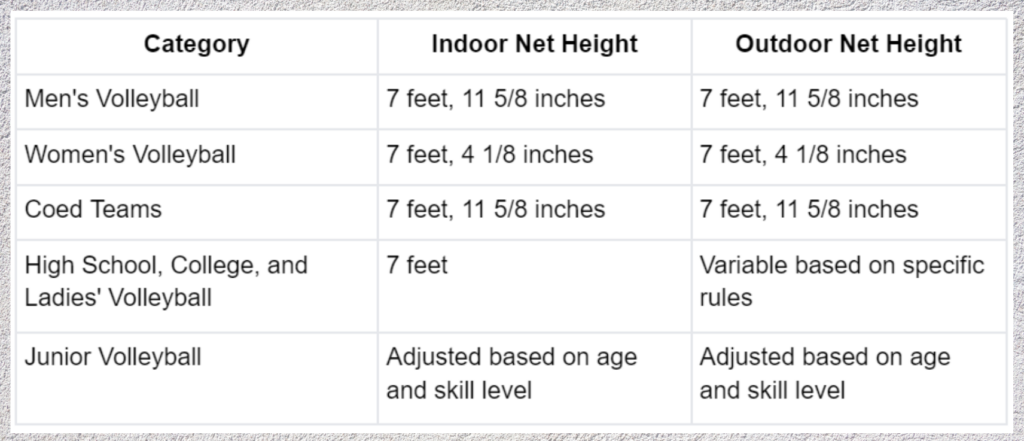
The official height of a volleyball net varies depending on the category of play. Setting the correct net height ensures fair competition and safety. Different leagues and organizations follow specific rules to maintain these heights. Understanding these standards helps players and coaches prepare effectively.
Men’s Standard Height
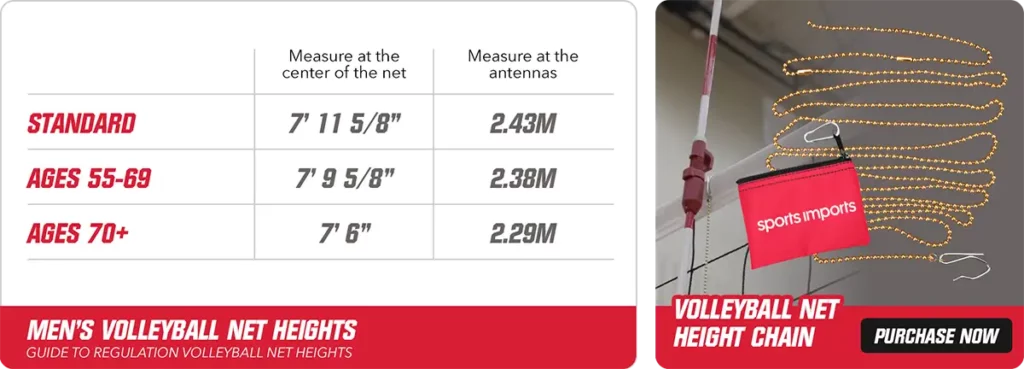
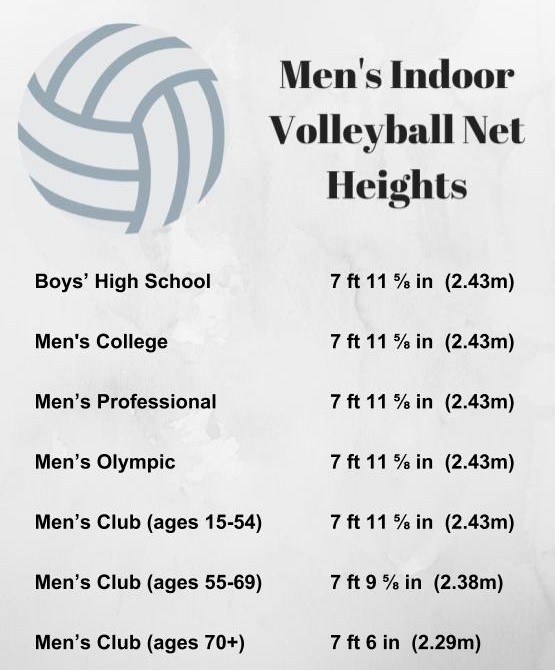
The official net height for men’s volleyball is 2.43 meters. This equals approximately 7 feet 11 5/8 inches. This height challenges players to develop strong jumping and hitting skills. It is used in professional, collegiate, and most amateur men’s competitions worldwide.
Women’s Standard Height
The official net height for women’s volleyball is 2.24 meters. This is about 7 feet 4 1/8 inches tall. It suits the average height and jumping ability of female players. Most women’s leagues, including international and college levels, follow this standard.
Co-ed And Recreational Heights
Co-ed and recreational volleyball often use a net height of 2.35 meters. This height balances the difference between men’s and women’s standards. Some recreational leagues also adjust net height to 1.98 meters for beginners or youth players. These variations make the game enjoyable for all skill levels.
Court Dimensions
The dimensions of a volleyball court play a crucial role in the sport. The size affects how players move and how the game is played. Both indoor and beach volleyball have specific court sizes set by official rules. Knowing these sizes helps players and coaches prepare better for matches.
Indoor Court Size
An indoor volleyball court measures 18 meters long and 9 meters wide. The court is divided into two equal halves by a net. Each half measures 9 meters by 9 meters. The playing surface is flat and smooth, usually made of wood or synthetic materials. Lines mark the boundaries and zones clearly for players and referees.
Beach Court Size
The beach volleyball court is smaller than the indoor one. It measures 16 meters long and 8 meters wide. The sand surface makes movement different and more challenging. The court is also divided by a net into two equal halves. Boundary lines are usually made with rope or tape laid on the sand.
Differences Between Court Types
Indoor courts are larger and have a hard surface. This allows faster movement and higher jumps. Beach courts are smaller with sand, which slows players down. The sand surface requires different skills and stamina. Net height remains official but the environment changes how the game feels.
Net Measurements
The official volleyball net has precise measurements to ensure fair play. The net size and support system follow strict rules. These details affect gameplay and player performance. Understanding net length, width, and pole setup is important for all players and organizers.
Net Length And Width
The net length for official volleyball is 9.5 to 10 meters (31 feet to 32 feet 9 inches). This length covers the court width and allows for tension adjustments. The net height varies by category but the width remains consistent.
The net width is 1 meter (3 feet 3 inches). It consists of a mesh with 10-centimeter (4-inch) square openings. This size stops the ball while allowing visibility and airflow during play.
Pole And Support Specifications
Poles must be strong and stable to hold the net tight. They stand outside the court, 0.5 to 1 meter (1.6 to 3.3 feet) from the sidelines. Poles are usually 2.55 meters (8 feet 4 inches) tall for men’s nets and 2.24 meters (7 feet 4 inches) for women’s nets.
The support system includes cables or straps to keep the net taut. It prevents sagging and ensures the net stays at the correct height during play. Proper pole padding is required for player safety near the posts.
Youth And Amateur Variations
Youth and amateur volleyball players often face different challenges than adults. Their skills and physical abilities vary widely. To support their growth and enjoyment, net heights and equipment adjust accordingly. These changes help young players learn the game more easily and safely.
Adjusted Net Heights For Youth
Youth volleyball nets are set lower than adult nets. This helps kids reach the ball comfortably. For example, net heights for ages 9-10 are usually around 1.83 meters (6 feet). Older youth players, ages 11-12, often use nets set at 2.13 meters (7 feet). These adjustments allow players to develop proper techniques.
The lower net height encourages confidence in serving, spiking, and blocking. It reduces frustration from trying to play at adult net heights. Coaches and leagues follow specific standards to match net height with players’ age and skill level.
Lighter Balls And Smaller Nets
Youth volleyballs are lighter and smaller than official adult balls. This makes handling and control easier for young players. Smaller balls reduce the impact on arms and wrists during play. It also improves passing and serving accuracy for beginners.
Along with lighter balls, some youth leagues use smaller nets. These nets have a narrower width to suit younger players’ reach. Combined with adjusted net heights, these equipment changes create a safer, more enjoyable environment. They allow kids to focus on learning skills without unnecessary difficulty.
Setting The Net
Setting the volleyball net at the correct height is vital for fair play. The official net height varies by category, but precision is key in all cases. A properly set net ensures players compete under standard conditions and enjoy the game fully.
Adjusting the net height should be done carefully using the right tools. Even small errors can affect gameplay and player safety. This section covers essential tools and common setup mistakes to avoid.
Tools For Accurate Setup
Use a tape measure or a net height gauge for exact measurement. A level tool helps keep the net straight across the top. Some nets come with built-in height markers for easier adjustment. A sturdy pole or stand is necessary to support the net firmly. Marking the poles with official heights can speed up future setups. These tools ensure the net meets official height requirements every time.
Common Mistakes To Avoid
Do not rely on guesswork or visual estimation alone. Avoid setting the net too high or too low, which can cause unfair play. Ensure the net is tight and not sagging in the middle. Check both sides of the net for equal height. Do not forget to secure the poles firmly to prevent movement. Regularly recheck the net height during long matches or events. Avoid these mistakes for consistent and fair volleyball games.
Credit: www.sportsimports.com
Regulatory Bodies
Volleyball net height is controlled by several key regulatory bodies. These organizations set clear rules to ensure fair play worldwide. Understanding these standards helps players and organizers maintain consistency. Each group focuses on different levels, from international to local play. Below is a breakdown of the main regulatory bodies and their guidelines.
Fivb Standards
The International Volleyball Federation (FIVB) governs official net heights worldwide. For men’s volleyball, the net height is set at 2.43 meters (7 feet 11 5/8 inches). Women’s net height is slightly lower, at 2.24 meters (7 feet 4 1/8 inches). These measurements apply to all international competitions under FIVB rules. The FIVB updates rules regularly to keep the sport fair and safe.
Ncaa And Avp Rules
In the United States, the NCAA and AVP control collegiate and professional volleyball standards. NCAA uses the same net heights as FIVB for men and women. Men’s net height remains 2.43 meters, and women’s is 2.24 meters. The AVP, focusing on beach volleyball, follows similar measurements but may adjust for co-ed and recreational play. Both organizations ensure rules fit their competition formats.
Local And Recreational Guidelines
Local leagues and recreational groups often adapt net heights for skill levels and age groups. Co-ed volleyball usually features a net height around 2.35 meters (7 feet 8 1/2 inches). Youth leagues set lower nets to match children’s abilities, often below 2 meters. These flexible rules encourage participation and learning. Local guidelines vary widely, so check with your league for exact standards.
Net Height Impact On Play
The height of the volleyball net directly shapes how the game unfolds. It controls the level of challenge for players during serves, spikes, and blocks. Different net heights create unique dynamics and strategies for each type of match. Understanding these impacts helps players adapt and improve their skills effectively.
Differences In Men’s And Women’s Play
The official net height for men is higher than for women. Men’s net stands at 2.43 meters (7 feet 11 5/8 inches). Women’s net is set at 2.24 meters (7 feet 4 1/8 inches). This difference affects the style of play and types of attacks used.
Men often rely on powerful spikes and strong blocks. The higher net demands more jumping ability and strength. Women use quicker plays and more technique to score. The lower net allows for more rallies and longer exchanges.
Adjusting to the net height changes how teams plan their offense and defense. It also influences player positions and roles on the court.
Co-ed Gameplay Considerations
Co-ed volleyball usually uses a net height between men’s and women’s standards. A common height is 2.35 meters (7 feet 8 1/2 inches). This middle ground balances the game for all players.
The mixed teams must work on communication and strategy. Men and women play different roles based on their strengths. The net height encourages teamwork and fair competition.
Co-ed games often focus on skill diversity and inclusiveness. Players must adapt to varied playing styles and pace. This net height creates fun and engaging matches for everyone.
Credit: volleyball-tips.com
Equipment Recommendations
Choosing the right volleyball equipment makes a big difference in playing quality. The net height must meet official rules for fair play. Proper nets and portable systems also enhance convenience and durability. Here are some key equipment recommendations for volleyball nets.
Choosing Quality Nets
Select nets made from strong, weather-resistant materials. Nylon and polyester are popular choices. These materials last longer outdoors and resist tearing. Look for nets with reinforced edges and sturdy mesh. Durable nets keep the official height stable during play. Proper net tension helps maintain consistent game conditions.
Portable Net Systems
Portable net systems offer flexibility for different locations. They usually include poles, bases, and adjustable net height settings. Choose systems with easy setup and takedown features. Lightweight frames improve transport and storage. Check for stable bases that prevent tipping during play. Portable systems work well for schools and recreational use.
Frequently Asked Questions
What Is A Volleyball Net Height?
The official volleyball net height is 2. 43 meters (7 feet 11 5/8 inches) for men and 2. 24 meters (7 feet 4 1/8 inches) for women. Co-ed or recreational nets typically stand at 2. 35 meters (7 feet 8 1/2 inches).
Is Size 5 The Official Volleyball Size?
No, size 5 is not the official volleyball size. The official volleyball size is typically size 5 for adults, but specifications vary by league and age group.
How Tall Is The Ncaa Net?
The NCAA volleyball net height is 7 feet 11 5/8 inches (2. 43 meters) for men. For women, it is 7 feet 4 1/8 inches (2. 24 meters). Co-ed recreational nets typically stand at 7 feet 8 1/2 inches (2.
35 meters).
What Is A Full-size Volleyball Net?
A full-size volleyball net measures 32 feet wide and 3 feet high. Official heights are 7 feet 11 5/8 inches for men and 7 feet 4 1/8 inches for women. It meets international standards for competitive play.
Conclusion
Knowing the official volleyball net height helps players and coaches prepare well. Men’s nets stand at 2. 43 meters high. Women’s nets are set slightly lower at 2. 24 meters. Co-ed or recreational nets usually measure around 2. 35 meters.
These standards keep the game fair and fun for everyone. Always check the rules before playing or setting up a court. This simple info improves your volleyball experience and skills. Keep practicing with the right net height for better play.