
Are you setting up a volleyball court or just curious about the official volleyball net size? Knowing the exact dimensions of the net is crucial whether you’re playing indoors, on the beach, or organizing a tournament.
The right net height and length can make all the difference in your game, helping you play by the rules and improve your skills. You’ll discover the official volleyball net size, including the precise measurements for men’s and women’s games, so you can ensure your court is perfectly set up every time.
Keep reading to get all the details you need and take your volleyball experience to the next level!

Credit: www.dimensions.com
Net Dimensions
The net dimensions are vital in volleyball. They set the boundaries and height for fair play. Every official match uses the same net size. This ensures consistency and fairness in the sport. Net dimensions include length, height, mesh size, and thickness.
Standard Length
The official volleyball net length measures 9.5 to 10 meters (31 feet to 32.8 feet). This length fits the width of the volleyball court perfectly. It stretches tightly from one side post to the other. The net must cover the entire court width without sagging.
Official Height For Men
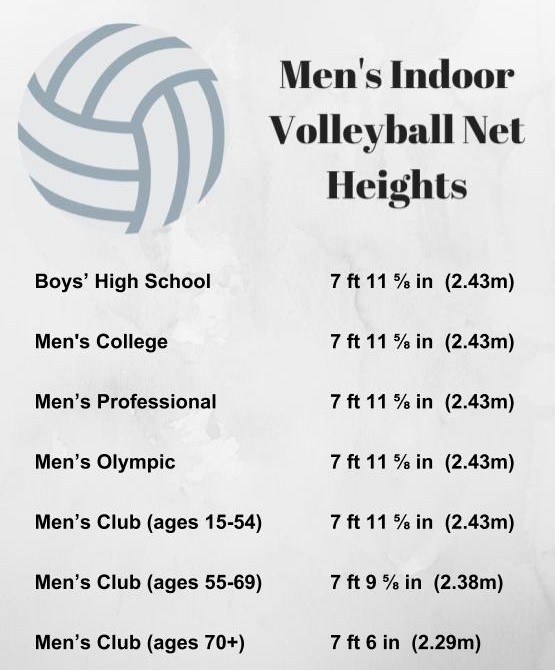
The official net height for men’s volleyball is 2.43 meters (7 feet 11 5/8 inches). This height challenges male players to jump and block effectively. It provides a balanced level of difficulty for competitive matches. Referees measure this height before games start.
Official Height For Women
Women’s volleyball nets stand at 2.24 meters (7 feet 4 1/8 inches). This height suits female players’ average reach and skill level. It allows for dynamic rallies and exciting gameplay. The net height remains consistent across all official women’s events.
Mesh Size And Thickness
The net mesh size is 10 centimeters (4 inches) square. This size prevents the ball from passing through easily. The mesh is made from durable nylon or polyethylene. The net thickness is strong enough to withstand impact but flexible for play. It must hold tension without tearing during matches.
Court Size And Layout
The court size and layout form the foundation for official volleyball play. Precise measurements ensure fairness and consistency. Different settings require specific dimensions for indoor and beach volleyball courts. The boundary lines and zones also define the play area clearly. Understanding these aspects helps players and organizers prepare the proper space for matches.
Indoor Court Dimensions
An official indoor volleyball court measures 18 meters long and 9 meters wide. The court is divided into two equal halves by the net. Each side measures 9 by 9 meters. The free zone surrounding the court must be at least 3 meters wide. The total playing area usually spans 30 by 18 meters to allow movement and safety.
Beach Court Dimensions
The beach volleyball court is smaller than the indoor court. It measures 16 meters long and 8 meters wide. The net divides the court into two equal halves of 8 by 8 meters. The free zone around the court should be at least 3 meters wide. The sand surface adds a unique challenge to the game.
Boundary Lines And Zones
Boundary lines mark the edges of the playing court. They are 5 centimeters wide and are part of the court. The attack line is drawn 3 meters from the centerline on each side. This line separates the front and back zones. The service zone extends behind the end line and is 9 meters wide. Proper markings help referees judge in or out calls accurately.
Net Materials And Construction
The quality of a volleyball net depends greatly on its materials and construction. These factors affect performance, durability, and safety during play. Nets must meet official size standards and also withstand constant tension and outdoor conditions. Understanding the common materials, durability features, and cord specifications helps in choosing the right volleyball net.
Common Materials Used
Volleyball nets commonly use nylon or polyethylene fibers. Nylon is strong and flexible, allowing good tension and less sagging. Polyethylene offers good resistance to water and UV rays. The top and bottom edges often have reinforced bands made of vinyl or polyester for extra strength. These materials ensure the net holds shape and provides consistent play experience.
Durability And Weather Resistance
Outdoor volleyball nets need to resist sun, rain, and wind. UV-resistant coatings protect fibers from sun damage. Water-resistant materials prevent mold and mildew growth. Reinforced stitching prevents tears from strong impacts. These features increase a net’s lifespan, especially in harsh weather. Indoor nets may focus more on strength and less on weatherproofing.
Cord And Cable Specifications
The net’s top cord must be strong to keep the net tight. Usually, a steel cable or heavy-duty braided cord runs through the top band. This cable supports tension and prevents stretching. The bottom cord is also reinforced but less heavy than the top. Side cords help attach the net to poles securely. Proper cord thickness and strength meet official volleyball standards.

Credit: www.networldsports.com
Regulation Differences
Volleyball nets have specific sizes set by different organizations. These sizes ensure fair play and consistency. The net height and length change depending on the level of play. Understanding these differences helps players prepare and compete properly.
The net size also varies by gender and age categories. Rules for high school, college, and professional levels are not the same. International competitions have their own standards too. Let’s explore these regulation differences in detail.
High School Standards
High school volleyball nets have strict height rules. For boys, the net height is 7 feet 11 5/8 inches (2.43 meters). For girls, it is 7 feet 4 1/8 inches (2.24 meters). The net length is usually 32 feet (9.75 meters). The mesh size is about 4 inches square to keep the ball from passing through.
These rules come from the National Federation of State High School Associations (NFHS). They focus on safety and skill development for teens. The net must be tightly secured and have a white band at the top.
Collegiate And Professional Rules
College volleyball follows rules set by the NCAA in the United States. The net height remains the same as high school for men and women. The net length is also about 32 feet. The mesh size and net materials meet higher durability standards for intense play.
Professional volleyball, including leagues like the AVP and FIVB, uses the same height rules. The net must be very strong to handle powerful spikes and serves. Officials check the net tension and height before each match.
International Variations
The International Volleyball Federation (FIVB) sets global standards. Their net height matches U.S. collegiate rules: 2.43 meters for men and 2.24 meters for women. The net length is 9.5 to 10 meters wide (31.2 to 32.8 feet).
Some countries may have small variations for youth or recreational leagues. Beach volleyball nets differ, with a slightly lower height and different length. Understanding these international rules helps players compete worldwide with ease.
Historical Net Sizes
Volleyball nets have not always been the same size. Their dimensions have changed since the sport began. These changes reflect the growth and development of volleyball worldwide.
Understanding the historical net sizes helps us appreciate the game’s evolution. It shows how rules adapted to improve play and fairness.
Original Net Dimensions
The first volleyball net was 30 feet long and 3 feet wide. The height was about 6 feet 6 inches for men and slightly lower for women. The mesh size was larger than today’s standards. Early nets were made from simple rope or twine.
Changes Over Time
As volleyball grew popular, net sizes were standardized. The length became 32 feet to cover the court width. The net height was set at 7 feet 11 5/8 inches for men and 7 feet 4 1/8 inches for women. Mesh sizes became smaller and more uniform.
These changes happened gradually, with official bodies approving new rules. Modern nets use durable materials like nylon or synthetic fibers.
Reasons For Adjustments
Adjustments aimed to make the game fair and competitive. Standard net sizes ensure all players compete under the same conditions. Better materials improved net strength and longevity. Smaller mesh sizes prevent the ball from getting stuck.
Changes also helped referees judge plays more accurately. Consistent net height supports skill development and player safety. Each adjustment reflects volleyball’s move towards professionalism.
Installation Tips
Installing an official volleyball net correctly is key for fair play and safety. Follow these installation tips to set up your net with precision. Proper setup ensures a smooth match and prevents damage to equipment.
Proper Net Tensioning
Keep the net tight but not too stiff. A properly tensioned net stays firm and does not sag. Use the adjustment cables or straps to pull the net evenly. Check both sides to maintain balance. Avoid over-tightening to prevent tearing the net.
Pole Placement
Place the poles firmly into the ground or their bases. They must be vertical and stable. The distance between poles should match the official net length, usually 9.5 to 10 meters. Use a measuring tape for accuracy. Secure poles with anchors or weights if needed.
Height Measurement Methods
Measure the net height from the center of the court. Use a tape measure or a marked pole. The official height is 2.43 meters for men and 2.24 meters for women. Check the height at several points to ensure consistency. Adjust the net height carefully using the pole mechanisms.
Common Mistakes To Avoid
Setting up the official volleyball net correctly is crucial for fair play and safety. Many players and organizers make avoidable errors that affect the game’s quality. Knowing common mistakes helps keep the net at the right size and position.
Errors in height, alignment, or equipment use can disrupt the game flow. These mistakes often happen during setup or replacement. Below are key points to watch out for.
Incorrect Height Settings
Setting the net too high or too low changes game difficulty. The official height differs for men and women. Men’s nets must be 2.43 meters (7 feet 11 5/8 inches). Women’s nets should be 2.24 meters (7 feet 4 1/8 inches). Using a tape measure ensures accuracy. Double-check height before starting play.
Improper Net Alignment
The net should be centered on the court and stretched tight. Loose or tilted nets cause unfair advantages. Make sure the net runs parallel to the sidelines. Check both ends for equal tension. A crooked net affects ball trajectory and player positioning.
Using Non-standard Nets
Non-standard nets vary in mesh size, length, and material. Official nets have mesh between 10 to 15 centimeters square. Length must be 9.5 to 10 meters. Using cheap or damaged nets leads to frequent breaks. Always choose nets that meet official dimensions and quality standards.
Credit: volleyball-tips.com
Choosing The Right Net
Choosing the right volleyball net is key for an enjoyable play. The net must fit your court size and playing style. Different settings need different types of nets. This guide helps you pick the perfect net for your needs. Consider the environment, budget, and trusted brands before buying.
Indoor Vs Outdoor Nets
Indoor volleyball nets differ from outdoor ones in materials. Indoor nets use lighter fabrics and thinner mesh. Outdoor nets are made with weather-resistant materials. They handle sun, rain, and wind better. Choose an indoor net for gym use. Pick an outdoor net for beaches or parks. The right net lasts longer and performs better.
Budget Considerations
Set a clear budget before buying a volleyball net. Quality and durability often increase with price. Basic nets suit casual players and beginners. More expensive nets offer stronger materials and better construction. Consider how often you will use the net. A cheap net may need replacing sooner. Balance cost with how long the net will last.
Brand Recommendations
Pick brands known for volleyball equipment quality. Park & Sun Sports makes durable volleyball nets. Vermont Sports offers nets for both indoor and outdoor play. MXY Sports provides nets with official dimensions and strong build. Choosing a well-known brand ensures proper size and good support. A reliable net improves your volleyball experience.
Frequently Asked Questions
What Is The Official Size For A Volleyball Net?
The official volleyball net size is 9. 5 to 10 meters long and 2. 43 meters high for men. For women, the height is 2. 24 meters. The net mesh size measures 10 centimeters per square. The net height is measured at the center and must not vary more than ¾ inch at the sides.
Is Volleyball Size 4 Or 5?
Volleyballs come in sizes 4 and 5. Size 5 is standard for adults, while size 4 suits youth players.
What Is A High School Volleyball Net?
A high school volleyball net measures 7 feet 4 1/8 inches tall for girls and 7 feet 11 5/8 inches for boys. It spans 29 feet 6 inches wide. The net features 2-inch mesh squares and a top white band.
This setup meets official high school volleyball standards.
What Were The Original Dimensions Of The Volleyball Net?
The original volleyball net measured 30 feet long and 3 feet wide. Its height was 6 feet 6 inches at the center.
Conclusion
Understanding the official volleyball net size is key for proper play. The net length is about 9. 5 to 10 meters. Men’s net height is 2. 43 meters, while women’s is 2. 24 meters. The mesh size usually measures 10 centimeters.
Keeping these measurements ensures fair and safe games. Whether playing indoors or on the beach, follow these standards. This knowledge helps players and organizers set up correctly. Clear net size rules make volleyball enjoyable for everyone.