Are you setting up a volleyball game and wondering what the regulation volleyball net size should be? Getting the net dimensions right is crucial to ensure fair play and a great experience on the court.
Whether you’re playing indoors or on the beach, knowing the exact height and length of the net can make all the difference in your game. In this guide, you’ll discover the official volleyball net sizes, how they vary for men’s and women’s games, and tips to help you measure and set up your net perfectly.
Keep reading to master the details that can elevate your volleyball matches to the next level!

Credit: www.networldsports.com
Volleyball Net Basics
The volleyball net is a crucial part of the sport. It divides the court and sets the challenge for players. Understanding the net’s size and height helps players and coaches prepare well. It also ensures the game is fair and meets official rules. Below are the basic facts about volleyball nets.
Standard Net Dimensions
A standard volleyball net measures 1 meter wide and 9.5 to 10 meters long. The mesh size is about 10 cm square. It is made of durable material to withstand outdoor and indoor play. The net must be tight and even to keep the game fair.
Net Height Variations
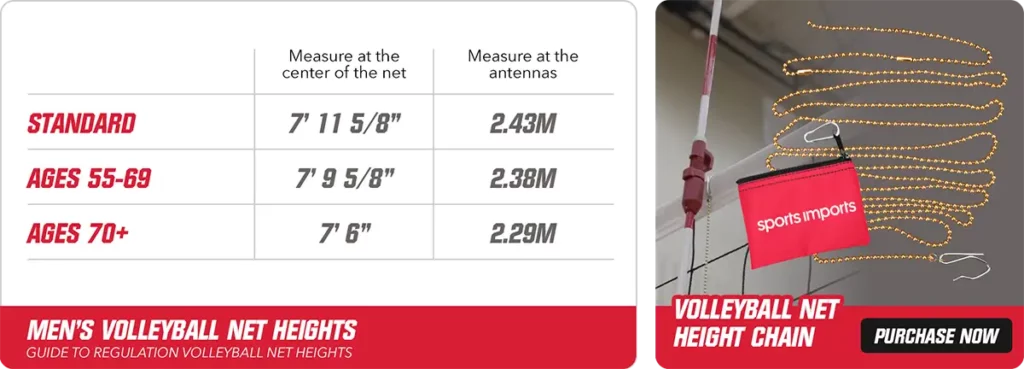
Net height changes based on the player’s age and gender. For men, the net is set at 2.43 meters (7 feet 11 5/8 inches). For women, the height is 2.24 meters (7 feet 4 1/8 inches). Youth players use lower nets, usually around 2.13 meters or less. Adjusting the net height helps players develop skills properly.
Net Length And Width
The net’s length covers the entire width of the court, about 9.5 to 10 meters long. The width is always one meter. These sizes keep the net stable and balanced. Proper length and width prevent the ball from passing outside the net during play.
Net Size For Indoor Volleyball
Indoor volleyball requires a net that fits strict size rules. The net size affects play and fairness. Different rules apply for men and women. The net height and court dimensions must meet official standards. Understanding these rules helps players and coaches prepare properly.
Men’s Net Height
The official net height for men is 2.43 meters (7 feet 11 5/8 inches). This height challenges players to jump higher and use strong attacks. It is the standard for all adult men’s indoor volleyball competitions. Setting the net at this height ensures fair play across all levels.
Women’s Net Height
Women’s indoor volleyball nets are lower than men’s. The net height for women is 2.24 meters (7 feet 4 1/8 inches). This height suits the average female player’s reach and jumping ability. It creates balanced competition and exciting rallies for women’s volleyball.
Court Size And Net Placement
The full court measures 18 meters long and 9 meters wide. The net divides the court exactly in half. It stretches across the 9-meter width line. Proper net placement keeps the game fair and organized. The net must be taut and stable for safe play.
Net Size For Beach Volleyball
The net size for beach volleyball is a key part of the sport’s setup. It affects how players play and how the game feels. Beach volleyball uses specific net dimensions that differ from indoor volleyball. These differences impact both the players and the style of play. Understanding the net size helps players and fans know the game’s rules better.
Official Beach Net Dimensions
The official net length for beach volleyball is 8.5 meters (28 feet). The net height is set at 2.43 meters (7 feet 11 5/8 inches) for men’s games. For women’s games, the net height is 2.24 meters (7 feet 4 1/8 inches). The net must be taut and have a white band along the top for visibility. Side bands mark the net’s width clearly.
Differences From Indoor Nets
Beach volleyball nets are shorter in length than indoor nets, which measure 9.5 meters (31 feet 2 inches). The height rules remain the same for both types of nets. Beach nets have a thicker mesh to resist outdoor conditions like wind and sun. Indoor nets are lighter and designed for controlled environments. The materials also differ to withstand weather changes on the beach.
Court Size And Layout
The beach volleyball court measures 16 meters long and 8 meters wide. It is smaller than an indoor court, which is 18 meters by 9 meters. The court is marked by boundary lines made of tape or rope. Sand surface affects player movement and ball bounce. The net stands in the middle, dividing the court into two equal halves.
Youth And Recreational Net Sizes
Youth and recreational volleyball players need nets suited to their size and skill levels. Standard adult nets can be too tall or heavy for younger players. Proper net sizes help children learn the game safely and enjoyably. Adjusting net height and size encourages better play and confidence. Many options exist to fit different ages and skill levels.
Smaller Net Options
Smaller nets make volleyball easier for kids. These nets have less width and height than regulation ones. They fit smaller courts and reduce the chance of injury. Coaches often choose nets sized specifically for youth leagues. These nets help young players develop skills without frustration. Compact nets also make setup and storage simpler.
Adjusting Net Height For Age Groups
Net height changes depending on the age group. For younger players, nets are set lower than adult standards. For example, under-12 players use nets around 7 feet tall. Older youth groups move closer to adult net heights. Adjusting height makes the game fair and fun for all ages. It supports growth in both skill and confidence.
Lightweight Nets For Beginners
Lightweight nets suit beginners who need easy handling. These nets use lighter materials without sacrificing strength. Beginners find it easier to set up and move lightweight nets. This helps coaches focus on teaching rather than equipment. Lightweight nets also reduce fatigue during long practice sessions.
Net Materials And Durability
The durability of a volleyball net depends largely on its materials. Choosing the right net material ensures long-lasting use and consistent performance. Nets made from strong fibers resist wear and tear during intense play. Durable nets maintain their shape and tension over time. Understanding net materials helps in selecting a net that fits your needs and environment.
Common Net Materials
Volleyball nets are mostly made from nylon, polyethylene, or polyester. Nylon nets are strong and flexible. They offer good resistance to stretching. Polyethylene nets resist moisture and UV rays well. Polyester nets combine strength and durability. Each material has benefits for different playing conditions.
Weather Resistance
Outdoor nets face sun, rain, and wind daily. Nets with UV protection last longer under sunlight. Water-resistant nets avoid damage from rain and humidity. Some nets come with coatings to prevent mold and mildew. Weather-resistant nets keep playing quality intact through seasons.
Maintenance Tips
Regular cleaning extends net life. Use mild soap and water to remove dirt. Avoid harsh chemicals that weaken fibers. Store nets in dry, cool places when not in use. Check for tears or loose threads often. Repair small damages quickly to prevent bigger problems.
Setting Up The Volleyball Net
Setting up the volleyball net correctly is essential for fair play. A properly installed net ensures the game runs smoothly and safely. Attention to detail during setup affects the quality of the match.
Follow these steps to set up the net with the right height, pole placement, and tension.
Measuring Net Height Accurately
Use a tape measure to check the net height from the center of the court. The official height is 2.43 meters (7 feet 11 5/8 inches) for men and 2.24 meters (7 feet 4 1/8 inches) for women. Measure from the playing surface to the top edge of the net. Ensure the net is level on both sides to keep the height consistent.
Pole Placement And Stability
Place the poles exactly on the court sidelines. Poles must be sturdy and firmly anchored. Use ground sleeves or heavy bases to keep poles stable. Poles that wobble or lean can cause the net to sag or fall during play. The distance between poles should match the court width of 9 meters (29 feet 6 inches).
Tension And Tightness
Apply even tension on the net to prevent sagging. Tighten the top cable or rope so the net stays straight. Check the net’s tightness at the center and adjust as needed. A loose net affects ball bounce and player performance. Keep the bottom band tight but avoid overstretching it to maintain net shape.
Regulatory Standards And Guidelines
Understanding the regulatory standards and guidelines for volleyball net size is essential for fair play. Different organizations set precise measurements to ensure consistency in the sport. These standards vary slightly depending on the level of competition and the type of play.
Fivb Net Regulations
The International Volleyball Federation (FIVB) sets global rules for volleyball nets. The official net length is 9.5 to 10 meters (31 feet 2 inches to 32 feet 10 inches). The net height differs by gender: 2.43 meters (7 feet 11 5/8 inches) for men and 2.24 meters (7 feet 4 1/8 inches) for women. The net must be 1 meter wide. White bands of 5 cm width are placed at the top and bottom of the net for visibility.
High School And Collegiate Standards
In the United States, high school and college volleyball follow slightly modified rules. The net length is usually 9.5 meters (31 feet 2 inches). The height for boys’ competition matches FIVB’s 2.43 meters, while girls’ nets are set at 2.24 meters. Some college leagues may have specific guidelines about net tension and posts to ensure safety and uniformity.
Local And Recreational Rules
Local leagues and recreational play often adapt net size rules for convenience. Nets may be shorter or adjustable to fit available space. Heights can be lowered for younger players or mixed teams. These variations keep the game accessible and fun for all ages and skill levels. Still, many local clubs try to stay close to official dimensions to prepare players for higher competition.

Credit: www.networldsports.com
Common Net Size Mistakes
Many players and organizers make simple mistakes with volleyball net sizes. These errors affect the play quality and rule compliance. Knowing the common net size mistakes helps avoid problems during matches. Proper net size ensures fair play and safety for all participants.
Incorrect Height Measurement
Measuring the net height wrong is a frequent mistake. The official height differs for men and women. Men’s net is set at 2.43 meters (7 feet 11 5/8 inches). Women’s net is 2.24 meters (7 feet 4 1/8 inches). Using a tape measure incorrectly or not checking from the right points causes errors. Always measure from the floor to the top of the net’s center.
Using Wrong Net Size For Level
Different volleyball levels require different net sizes. High school, college, and recreational leagues may have varying rules. Beach volleyball nets also differ in length and height from indoor nets. Using a net meant for another level or type can break rules and confuse players. Confirm the correct net size for your specific competition or practice.
Improper Installation Issues
Improper net installation leads to loose or uneven nets. The net should be tight and level across the entire length. Poles must be stable and at the right distance apart, usually 9 meters. Failure to secure the net properly causes sagging or shifting during play. Check the tension and pole alignment before every match.
Choosing The Right Volleyball Net
Choosing the right volleyball net is essential for a great playing experience. The net size and type affect the game flow and player comfort. Different nets suit various play levels and environments. Understanding these differences helps pick the best net for your needs.
Matching Net To Play Level
Begin by selecting a net that fits the skill level. Official regulation nets suit competitive and advanced players. Recreational players may prefer nets that are easier to set up and adjust. Youth nets are lower to help younger players learn the game. Choose a net size that matches the players’ abilities for fair play and safety.
Indoor Vs Outdoor Nets
Indoor and outdoor volleyball require different net types. Indoor nets are made from lighter materials and have tighter mesh. Outdoor nets are built to withstand weather and rough use. They often have thicker ropes and stronger poles. Pick a net designed for your playing environment to ensure durability and performance.
Budget And Quality Considerations
Balance cost with quality when choosing a volleyball net. Low-cost nets work well for casual play but may wear out quickly. Higher-quality nets provide better tension and last longer. Look for nets with reinforced edges and strong poles. Investing in a good net saves money over time and improves play experience.
Credit: www.sportsimports.com
Frequently Asked Questions
What Is The Size Of A High School Volleyball Net?
A high school volleyball net measures 32 feet long and 7 feet 4 inches wide. The net height is 7 feet 4 1/8 inches for girls and 7 feet 11 5/8 inches for boys.
What Is A Full-size Volleyball Net?
A full-size volleyball net measures 32 feet (9. 75 meters) wide and 3 feet (0. 91 meters) tall. The height is 7 feet 11 5/8 inches (2. 43 meters) for men and 7 feet 4 1/8 inches (2. 24 meters) for women.
Is Size 5 The Official Volleyball Size?
Yes, size 5 is the official volleyball size used in professional and international matches. It measures about 65-67 cm in circumference.
What Is The Correct Measurement Of The Net In Volleyball?
The correct volleyball net measures 9. 5 to 10 meters (31 to 32 feet) long and 1 meter (3. 3 feet) high. Men’s net height is 2. 43 meters; women’s is 2. 24 meters.
Conclusion
A regulation volleyball net size ensures fair play and consistency. Men’s nets stand at 2. 43 meters high, women’s at 2. 24 meters. Court dimensions and net height affect how the game is played. Knowing these standards helps players prepare correctly.
Whether indoor or beach volleyball, following rules keeps matches official. Always check net size before playing to avoid confusion. Proper net height supports skill development and enjoyable games. Understanding these basics makes volleyball more fun and competitive for everyone.