Are you setting up a volleyball court or upgrading your current gear? Knowing the standard height of a volleyball net is crucial for fair play and improving your game.
Whether you’re playing indoors or on the beach, for men’s, women’s, or youth leagues, the net height can make all the difference in how the game flows and how you perform. You’ll discover the exact measurements that define the official volleyball net height, why they matter, and how adjusting the net to the right height can enhance your volleyball experience.
Keep reading to make sure your court is set up just right and get ready to serve, spike, and block with confidence!
Net Height Standards
Volleyball net height plays a key role in fair play and skill development. Different groups follow specific height standards. These standards ensure the game is safe and enjoyable for all players.
Understanding these heights helps coaches, players, and organizers set up courts correctly. The International Volleyball Federation (FIVB) sets official heights for men and women. Youth leagues adjust heights based on age for better learning.
Men’s Net Height
The official net height for men is 2.43 meters (7 feet 11 5/8 inches). This height is standard in professional and adult male competitions worldwide. It challenges players to develop strong skills in jumping and spiking. Some recreational leagues may allow slight adjustments.
Women’s Net Height
Women’s net height is set at 2.24 meters (7 feet 4 1/8 inches). This height suits the average reach and skill level of female players. It encourages fast-paced, strategic play. Many women’s leagues and tournaments follow this exact standard.
Youth And Age Variations
Youth volleyball nets vary by age group to support skill growth. Younger players often use nets as low as 1.8 meters (5 feet 11 inches). As children grow, net height increases gradually toward adult standards. These changes help improve confidence and technique.

Credit: www.networldsports.com
Measuring Net Height
Measuring the height of a volleyball net is crucial for fair play and official matches. The net must be set at a precise height to meet standards for different genders and age groups. Accurate measurement ensures players compete under the correct conditions. The process involves checking the net at the center and making adjustments on the sides. Below are the key steps and rules for measuring volleyball net height.
Center Court Measurement
Measure the net height at the exact center of the court. Use a tape measure or a specialized net gauge. The official height for men’s volleyball nets is 2.43 meters (7 feet 11 5/8 inches). For women’s nets, the height is 2.24 meters (7 feet 4 1/8 inches). Place the measuring tool on the floor and extend it to the top edge of the net. Ensure the net is tight and straight before measuring. This spot gives the most accurate height reading.
Side Adjustments Rules
After measuring the center, check the net height on both sides. The sides can be slightly lower than the center, but not by more than 2 centimeters. Use the net tensioning system to adjust the height at the poles. Follow official rules from volleyball governing bodies to avoid penalties. The net must remain level across its entire length. Proper side adjustments help maintain consistent play and prevent unfair advantages.
Net Setup Essentials
Setting up a standard height volleyball net correctly is key for a fair and fun match. The net must be stable and at the right height. This section covers the essentials needed to set up your volleyball net properly.
Follow these simple steps to ensure your net is ready for play. Proper setup improves safety and game quality.
Choosing The Right Net
Select a net that matches the standard height for your game level. For men’s games, the net height is 2.43 meters (7 feet 11 5/8 inches). Women’s games use a net at 2.24 meters (7 feet 4 1/8 inches). Ensure the net material is durable and weather-resistant for outdoor use.
Check the net width and length to fit your court size. A standard net is about 9.5 to 10 meters wide.
Proper Installation Techniques
Start by fixing the poles securely in the ground or on stable bases. The net should be tight but not overly stretched. Use the adjustable straps or ropes to raise the net to the correct height.
Ensure the net is even on both sides to avoid unfair advantages. Check the tension frequently during play and adjust if needed.
Tools Needed For Setup
Have a tape measure to verify net height and width. Use a wrench or spanner to tighten pole fittings. Rope or straps help secure the net to the poles firmly.
A level tool can help check pole verticality. Carry scissors or a knife to trim excess rope. These simple tools make setup easier and safer.

Credit: www.dimensions.com
Indoor Vs Outdoor Nets
The choice between indoor and outdoor volleyball nets affects play quality and net durability. Both types meet the standard height requirements but differ in build and features. Understanding these differences helps pick the right net for your environment.
Differences In Net Materials
Indoor volleyball nets use lighter materials designed for controlled environments. Nylon and polyester are common for indoor nets, offering smooth texture and flexibility. These materials resist wear from indoor lighting and less exposure to weather.
Outdoor nets require stronger, weather-resistant materials. Vinyl-coated polyester or polyethylene is typical for outdoor nets. These materials resist sun damage, rain, and wind, keeping the net durable in harsh conditions.
Height Adjustments For Environments
Standard net height is 2.43 meters (7 feet 11 5/8 inches) for men and 2.24 meters (7 feet 4 1/8 inches) for women. Indoor nets usually have fixed height poles for stability. Adjustments are less frequent indoors due to consistent playing surfaces.
Outdoor nets often feature adjustable poles. This allows players to change net height for different skill levels or age groups. Wind and uneven ground outdoors make adjustable setups more practical for safe play.
Regulation Compliance
Regulation compliance ensures volleyball nets meet official standards. Proper net height affects fair play and safety. Different organizations set specific rules for net measurements. Understanding these rules helps players and organizers maintain game integrity.
Fivb Guidelines
The International Volleyball Federation (FIVB) sets global standards. For men, the net height is 2.43 meters (7 feet 11 5/8 inches). For women, it is 2.24 meters (7 feet 4 1/8 inches). These heights apply to official international competitions. The FIVB also defines net length and antenna placement.
Usa Volleyball Rules
USA Volleyball follows FIVB rules with slight adjustments. The net height matches international standards for men and women. Youth divisions use lower net heights based on age groups. These rules support player development and safety at all levels.
High School And Recreational Standards
High schools adopt similar net heights to USA Volleyball. Boys’ nets are usually set at 2.43 meters and girls’ at 2.24 meters. Recreational leagues may vary net height for skill levels and age. Consistency with regulations promotes fairness and enjoyment for all players.
Common Setup Mistakes
Setting up a volleyball net at the correct standard height is essential for fair play and safety. Many people make common mistakes during setup that affect gameplay. These errors can cause frustration and disrupt the flow of the game. Understanding these mistakes helps you avoid them and ensures a smooth setup process.
Incorrect Height Measurement
Measuring the net height incorrectly is a frequent error. The standard height for men’s volleyball nets is 2.43 meters (7 feet 11 5/8 inches). For women, it is 2.24 meters (7 feet 4 1/8 inches). Using a faulty tape measure or not measuring from the right points causes the net to be too high or too low. Always measure from the ground to the top of the net’s center. Double-check the height before finalizing the setup.
Uneven Tension Issues
Uneven tension on the volleyball net leads to sagging or tight spots. This mistake affects ball movement and player performance. Tighten the side cables and center straps evenly to keep the net flat and firm. Check the tension regularly during play. Uneven tension can cause the net to lean or bounce unpredictably, creating an unfair advantage.
Improper Anchoring
Improper anchoring makes the net unstable and unsafe. The poles should be secured firmly in the ground or weighted bases. Loose or weak anchoring allows poles to shift or fall during play. Use strong anchors or stakes designed for volleyball nets. Proper anchoring ensures the net stays in place and protects players from accidents.
Maintenance Tips
Maintaining a standard height volleyball net ensures long-lasting use and optimal play. Simple care routines keep the net in good shape and prevent damage. Regular attention to the net and its components avoids costly repairs or replacements.
Regular Height Checks
Check the net height before every game. Use a reliable measuring tool for accuracy. The standard height is 2.43 meters for men and 2.24 meters for women. Adjust the net tension to keep the height consistent. Uneven height can affect the quality of play and safety.
Net And Pole Care
Inspect the net for tears or fraying regularly. Repair small damages quickly to prevent worsening. Clean the net with mild soap and water to remove dirt. Avoid harsh chemicals that can weaken the material. Check the poles for rust or loose parts. Tighten bolts and replace damaged components as needed.
Storage Recommendations
Remove the net and poles after use, especially outdoors. Store them in a dry, cool place to avoid mold and rust. Use a bag or cover to protect the net from dust and pests. Proper storage extends the net’s life and keeps it ready for the next game.
Adjusting For Special Formats
Volleyball net heights change to suit different play styles and player needs. Standard heights fit most adult leagues. Special formats require adjustments to keep the game fair and fun. These variations help players enjoy volleyball in new ways.
Sitting Volleyball Nets
Sitting volleyball uses a lower net to fit seated players. The net height is 1.15 meters (3 feet 9 inches). This height makes it easier to serve and block while sitting. Courts are smaller, and rules adjust for fast-paced play.
Beach Volleyball Net Height
Beach volleyball nets are slightly different. Men’s nets stay at 2.43 meters (7 feet 11 5/8 inches). Women’s nets are set at 2.24 meters (7 feet 4 1/8 inches). Sand changes jumping and movement, so net heights remain the same as indoor play.
Youth League Adaptations
Youth volleyball uses lower nets for younger players. Heights vary by age group to match skill and strength. For example, kids under 12 play with nets around 1.8 meters (5 feet 11 inches). This helps children learn proper techniques comfortably.
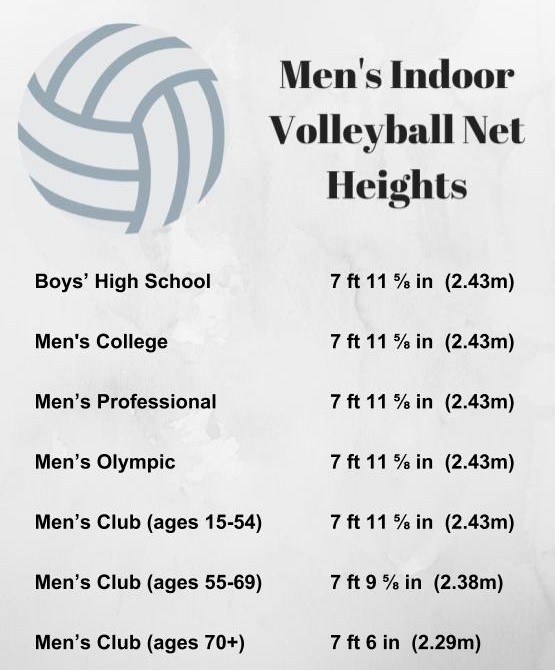
Credit: volleyball-tips.com
Frequently Asked Questions
What Is The Standard Volleyball Net Height?
The standard volleyball net height is 2. 43 meters (7 feet 11 5/8 inches) for men and 2. 24 meters (7 feet 4 1/8 inches) for women. Youth and recreational leagues often use lower net heights based on age and skill level.
How Tall Is The Net For High School?
The high school volleyball net height is 7 feet 4 1/8 inches (2. 24 meters). This standard applies to girls’ and women’s competitions. Boys’ and men’s nets are higher, at 7 feet 11 5/8 inches (2. 43 meters). Heights vary by age and level.
Is The Volleyball Net 3 Feet High?
No, a standard volleyball net is not 3 feet high. It measures 7 feet 11 5/8 inches for men and 7 feet 4 1/8 inches for women. Net height varies by age and level of play but is always significantly higher than 3 feet.
How Big Is A Full-size Volleyball Net?
A full-size volleyball net measures 32 feet long and 3 feet wide. Its standard height is 7 feet 11 5/8 inches for men and 7 feet 4 1/8 inches for women.
Conclusion
The standard height volleyball net ensures fair play for all players. Men’s nets stand at 7 feet 11 5/8 inches, while women’s nets measure 7 feet 4 1/8 inches. These measurements keep the game consistent worldwide. Different leagues or age groups may use adjusted net heights.
Knowing the correct net height helps players improve their skills and enjoy the game. Whether for indoor or beach volleyball, following these standards matters. Keep this information in mind for your next volleyball match or practice.