Are you curious about how tall volleyball nets really are? Whether you’re a player, coach, or just a fan, knowing the exact height of a volleyball net is essential.
The net’s height can change the way the game feels—affecting your serves, spikes, and blocks. You’ll discover the official net heights for men’s, women’s, and youth volleyball, plus some interesting variations you might not expect. Ready to get the facts that will help you improve your game or satisfy your curiosity?
Keep reading to find out everything you need to know about volleyball net heights!

Credit: www.dimensions.com
Official Net Heights
The official heights of volleyball nets vary by category and follow international standards. These heights ensure fair play and consistency in competitions worldwide. Understanding these net heights helps players and coaches prepare better for matches and training sessions.
Men’s Standard Height
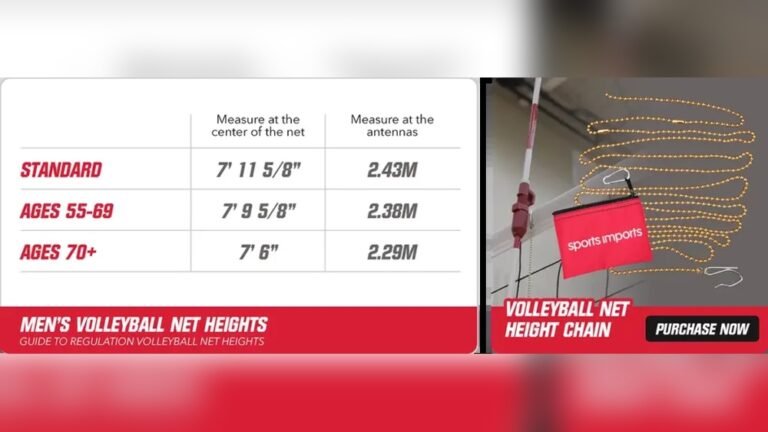
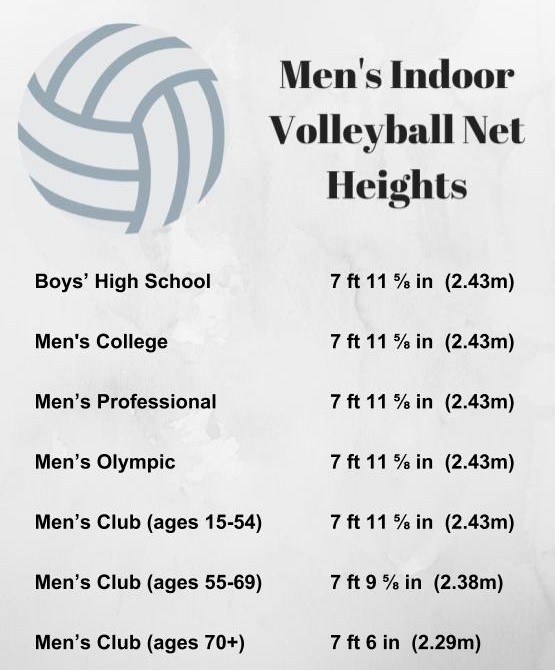
The official net height for men’s volleyball is 2.43 meters. This equals about 7 feet 11 and 5/8 inches. This height challenges players to jump higher and improve their spiking and blocking skills. It is the standard used in most adult men’s leagues and tournaments.
Women’s Standard Height
The net height for women’s volleyball is set at 2.24 meters. This is about 7 feet 4 and 1/8 inches tall. It allows female players to compete fairly and use their speed and technique. This height is common in professional and amateur women’s volleyball events.
Coed Net Height Variations
Coed volleyball leagues may use different net heights. Some use the men’s height of 2.43 meters. Others choose a middle height between men’s and women’s standards. This helps balance the competition when both genders play together. The exact height depends on league rules and player preferences.
Youth Volleyball Nets
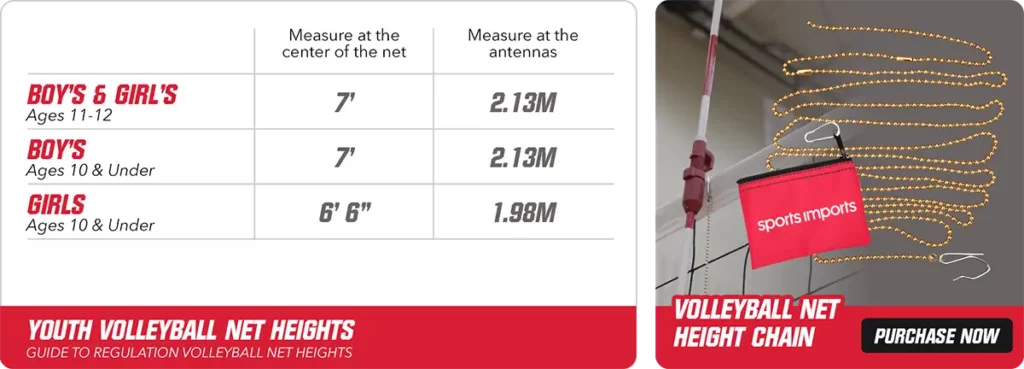
Youth volleyball nets differ from adult nets in height. These nets adjust to fit children’s growing skills and sizes. Using the right net height helps young players enjoy the game. It also aids in learning proper techniques early on.
Age Group Adjustments
Net height changes based on players’ ages. Younger kids use lower nets to match their reach. As players grow, the net height increases gradually. This approach supports skill development and safety.
Benefits Of Lower Nets
Lower nets make it easier for kids to hit the ball. This builds confidence and encourages participation. It reduces frustration from missed plays. Kids can focus on learning rules and teamwork.
Common Youth Net Heights
Youth net heights vary by age group and gender. For ages 8 and under, nets stand around 5 feet. Ages 9 to 12 use nets about 6 feet tall. Older youth players, 13 to 14, play with nets near 7 feet. These heights prepare players for standard adult nets later.
Indoor Vs Beach Net Heights
The height of a volleyball net varies between indoor and beach volleyball. These differences affect how players serve, block, and spike. Understanding net height is key for playing the sport correctly. The rules set clear standards for both types of volleyball.
Differences In Net Height
Indoor volleyball nets are typically higher than beach nets. For men’s indoor volleyball, the net stands at 2.43 meters (7 feet 11 5/8 inches). Women’s indoor nets are set at 2.24 meters (7 feet 4 1/8 inches). Beach volleyball nets follow the same heights but can vary slightly in recreational play. The extra height indoors challenges players to jump and reach higher.
Court Size Impact
Indoor courts are larger, measuring 18 by 9 meters. This space allows for more players and complex plays. Beach courts are smaller, usually 16 by 8 meters. The smaller court size means players cover more ground quickly. Net height complements court size to balance gameplay difficulty and player ability.
Net Setup For Beach Volleyball
Beach nets use flexible poles that adjust to windy conditions. The net must be tight but able to move slightly. Sand courts require different anchoring to keep the net stable. This setup helps maintain fair play even with outdoor weather changes. Correct net height and tension are crucial for match quality.
Credit: www.sportsimports.com
Measuring Volleyball Nets
Knowing the exact height of a volleyball net is important for fair play. Measurement ensures the net meets official standards. This helps players perform at their best and enjoy the game.
Measuring a volleyball net requires precision and the right tools. The process is simple but must be done carefully. Below are key points to help you measure the net correctly.
Tools Needed
Use a tape measure that shows both feet and meters. A level can help check if the net is straight. Having a step ladder is useful for reaching the top. These tools make measurement easier and more accurate.
Accurate Measurement Tips
Measure from the ground to the top of the net’s center. Ensure the tape is straight and not slanted. Check the poles to see if the net is tight and even. Measure at several points to confirm the height is consistent.
Common Measurement Mistakes
Avoid measuring from the ground to the bottom of the net. Do not measure on uneven ground or soft surfaces. Avoid bending the tape or letting it sag. Do not rely on guesswork; always use proper tools for exact results.
History Of Net Heights
The history of volleyball net heights reflects the sport’s growth and changing needs. Nets did not always have fixed measurements. Early volleyball games used various net heights depending on players’ preferences and local rules. Over time, official standards were created to make the sport fair and consistent worldwide.
Evolution Of Standards
In volleyball’s early days, net heights varied greatly. Local clubs and schools often set their own rules. As the sport grew, a need for uniformity appeared. The first official standards were introduced in the 1920s and 1930s. These helped standardize net height and court size. The International Volleyball Federation (FIVB) later refined these rules. They aimed to create clear, consistent guidelines for all competitions.
Changes In Men’s And Women’s Heights
Men’s and women’s net heights have not always been different. Originally, a single net height was used for all players. Over time, experts realized men and women have different average heights and jumping abilities. This led to separate standards for each gender. Today, the official height is 2.43 meters (7 feet 11 5/8 inches) for men. For women, it is 2.24 meters (7 feet 4 1/8 inches). These heights balance fairness and challenge in the game.
Influence Of Governing Bodies
Governing bodies shape volleyball net height rules. The FIVB plays the biggest role worldwide. It sets regulations for international competitions. National organizations follow these standards for local play. Youth and amateur leagues sometimes adjust net heights further. This helps younger or less experienced players enjoy the game. Governing bodies continuously review and update rules. This keeps volleyball fair and fun for all skill levels.
Adjusting Net Heights For Different Levels
Volleyball net heights vary across different levels to suit players’ skills and ages. Adjusting net heights helps create fair and enjoyable play. Each level has specific rules for net height that players and coaches must follow. These adjustments ensure proper competition and safety for all participants.
High School Regulations
High school volleyball nets follow official rules set by governing bodies. For boys, the net height is usually 2.43 meters (7 feet 11 5/8 inches). Girls play with nets at 2.24 meters (7 feet 4 1/8 inches). These heights balance challenge and fairness for teenagers. Schools must measure nets before matches to meet these standards.
College And Professional Standards
College and professional volleyball use the same net heights as high school boys and girls. Men’s nets stay at 2.43 meters, while women’s nets remain at 2.24 meters. These heights reflect the advanced skill and strength of older players. Officials check net heights carefully in tournaments and leagues. Consistent net height supports high-level competition and player performance.
Recreational Play Modifications
Recreational leagues often adjust net heights for fun and inclusivity. Children’s leagues use lower nets to help young players learn the game. Mixed or casual groups may choose net heights that suit all players’ comfort. Flexibility in net height encourages participation and enjoyment. This approach helps grow interest in volleyball at all ages.
Impact Of Net Height On Gameplay
The height of a volleyball net plays a crucial role in shaping the gameplay. It directly affects how players perform, the strategies teams use, and the risks of injury. Different net heights create different challenges and opportunities on the court. Understanding these impacts helps players and coaches prepare better for matches.
Player Performance
Net height influences players’ jumping and hitting abilities. Taller nets require higher jumps to spike or block the ball. This tests players’ strength and timing. Lower nets allow faster attacks and easier blocks. Adjusting to net height can improve a player’s skill over time. It also impacts endurance, as higher nets demand more energy.
Strategy Adjustments
Teams change their tactics based on the net height. A higher net slows down quick attacks and favors strong blockers. Teams may focus more on powerful serves and long rallies. Lower nets encourage fast plays and quick sets. Coaches plan plays that fit the net’s challenge. Strategy shifts help teams use their strengths effectively.
Injury Prevention
Proper net height reduces injury risks during play. Nets set too high force players to overreach, causing strain. Nets set too low may lead to awkward landings or collisions. Official net heights follow safety standards to protect players. Training with the correct net height builds better form. This lowers the chance of muscle or joint injuries.
Credit: volleyball-tips.com
Setting Up And Maintaining Nets
Setting up and maintaining volleyball nets requires attention to detail. Proper net height ensures fair play and safety. Regular care keeps the net durable and ready for use. Follow these steps to install and maintain your volleyball net correctly.
Proper Installation Techniques
Start by choosing strong poles that fit the net size. Measure the court to set poles at correct distances. Attach the net securely to the poles. Use tension ropes to keep the net tight and straight. Check the net height with a measuring tape. For men’s games, set the net at 7 feet 11 5/8 inches. Women’s net height is 7 feet 4 1/8 inches. Adjust height for youth games as needed. Make sure the net is level and stable before play.
Regular Maintenance Tips
Inspect the net before every game or practice. Look for loose ropes or damaged mesh. Tighten any slack in the net or ropes. Clean the net with mild soap and water to remove dirt. Avoid harsh chemicals that can weaken the material. Store the net in a dry place after use. Protect the net from direct sunlight to prevent fading. Replace worn parts promptly to extend net life.
Handling Wear And Tear
Volleyball nets face wear from weather and use. Check the mesh for holes or frayed edges. Repair small tears with strong thread or patch kits. Replace ropes and tension cords if they start to fray. Keep the poles rust-free and secure. Avoid leaving nets outside in heavy rain or snow. Regular care reduces damage and keeps the net safe. A well-maintained net improves the playing experience.
Future Trends In Net Heights
Volleyball net heights have stayed mostly the same for years. Changes could come soon to match new player needs and styles. Adjusting net heights could improve play for all skill levels.
New rules and designs may change the way we see volleyball nets. These changes aim to make the sport safer and more fun for everyone. Let’s explore some key future trends in net heights.
Potential Rule Changes
Officials may consider changing net heights for different leagues. This helps balance fairness and challenge across age and skill groups. Rule updates could also support mixed-gender games better.
Lower nets might become standard in youth volleyball to aid skill development. Senior leagues could see adjusted heights to reduce injury risk. The goal is better play and more player enjoyment.
Innovations In Net Design
Net materials and structures are evolving for strength and flexibility. New nets may include adjustable height features for quick changes. This allows easy use across multiple player groups and events.
Lightweight and durable nets can improve setup and transport. Some designs focus on reducing net movement during play. These innovations help keep the game fair and consistent.
Youth And Senior Player Considerations
Younger players benefit from lower nets to build confidence and skills. Seniors may need nets adjusted to protect joints and muscles. Tailoring net height helps keep players active longer.
Training with the right net height improves player safety and technique. Coaches and leagues may adopt flexible height rules for better inclusivity. This trend supports volleyball growth at all ages.
Frequently Asked Questions
How Tall Is An Actual Volleyball Net?
A standard men’s volleyball net height is 2. 43 meters (7 feet 11 5/8 inches). Women’s nets stand at 2. 24 meters (7 feet 4 1/8 inches). Youth nets vary by age but are generally lower than adult heights.
How Tall Is A 12 Year Old Girl Volleyball Net?
A 12-year-old girl’s volleyball net is typically set at 7 feet 0 inches (2. 13 meters) high. This height suits youth volleyball standards.
Is The Volleyball Net 3 Feet High?
No, a standard volleyball net is not 3 feet high. Men’s net height is 7 feet 11 5/8 inches. Women’s net height is 7 feet 4 1/8 inches. Youth nets are lower but generally above 3 feet.
What Is The Height Of The Net In 7th Grade Volleyball?
The net height for 7th grade volleyball is typically 7 feet 4 inches (2. 24 meters). This height suits middle school players.
Conclusion
Volleyball nets have specific heights for different players. Men’s nets stand at 7 feet 11 5/8 inches tall. Women’s nets are slightly lower, at 7 feet 4 1/8 inches. Youth leagues often use shorter nets to fit younger players. Knowing these heights helps players practice better and enjoy the game.
Setting the net right is key to fair play. Whether indoors or on the beach, the net height stays consistent. Remember, proper net height makes volleyball fun and challenging. Keep these measurements in mind for your next game.