Are you curious about the exact height of a volleyball net and why it matters so much in the game? Whether you’re setting up for a friendly match, coaching a team, or just want to understand the rules better, knowing the right net height can make a huge difference in how you play and enjoy volleyball.
You’ll discover the official net heights for men, women, and co-ed games, and how these measurements impact your strategy and performance. Stick with me, and you’ll never wonder about volleyball net height again—it’s simpler than you think, and it could transform your next game.
Net Height Standards
The net height in volleyball is a key part of the sport’s rules. It changes depending on the players’ gender, age, and level of play. These standards ensure fair play and proper competition. The official heights are set by volleyball organizations worldwide.
Knowing the correct net height helps players practice better and enjoy the game. It also helps coaches and referees set up the court properly. Below are the standard net heights for different categories.
Men’s Net Height
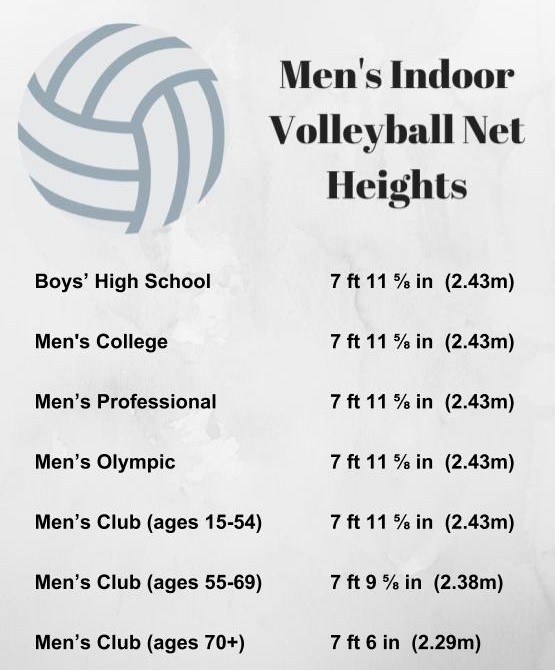
The official net height for men’s volleyball is 2.43 meters (7 feet 11 5/8 inches). This height suits the strength and jumping ability of male players. It is used in most professional and amateur men’s competitions worldwide.
Women’s Net Height
For women, the official net height is 2.24 meters (7 feet 4 1/8 inches). This standard allows fair play based on average female athlete capabilities. Women’s volleyball games follow this height in all official tournaments.
Co-ed And Recreational Heights
Co-ed volleyball often uses a net height between the men’s and women’s standards. The usual height is 2.35 meters (7 feet 8 1/2 inches). Recreational leagues may adjust this height for fun or skill level. This helps balance competition among mixed teams.
Youth Net Height Variations
Youth volleyball uses lower net heights to match children’s growth and skill levels. Heights vary by age group, starting as low as 1.98 meters (6 feet 6 inches) for younger players. This adjustment helps young athletes learn the game safely and enjoyably.

Credit: www.dimensions.com
Measurement Techniques
Measuring the net volleyball height is key for fair play and proper setup. Accurate measurement ensures the net meets official standards. This section explains how to measure volleyball net height correctly.
Follow simple steps and use the right tools to get the exact height. Avoid common errors that can cause the net to be too high or low.
Tools Needed
Use a tape measure or a measuring stick marked in feet and inches. A ladder or step stool helps reach the top of the net. A level tool ensures the net is straight and not tilted. Markers or chalk can help mark the exact height on the poles.
Proper Measurement Steps
First, place the tape measure on the ground directly under the net. Next, extend it straight up to the top edge of the net’s center. Check the height at the middle, not the sides. Use a level to confirm the net is even across its width. Adjust the net’s tension to keep it tight and straight. Record the height and compare it to official standards for men, women, or co-ed play.
Common Mistakes To Avoid
Do not measure the net from the side or an angle. Avoid measuring the height when the net is loose or sagging. Don’t ignore the difference between the center and the poles’ height. Avoid using tools that give inaccurate or rounded numbers. Never guess the height without measuring. These mistakes lead to unfair play and can cause rule violations.
Court Dimensions And Net Placement
The court dimensions and net placement play a vital role in volleyball. They set the stage for fair play and proper competition. Both indoor and beach volleyball have specific measurements. The net height and position follow strict rules. Understanding these details helps players and fans appreciate the sport more.
Indoor Court Size
An indoor volleyball court measures 18 meters long and 9 meters wide. The court is divided into two equal halves by the net. Each half measures 9 by 9 meters. The playing surface is smooth and hard. Lines mark the boundaries clearly for players and referees.
Beach Volleyball Court Size
The beach volleyball court is smaller than the indoor court. It measures 16 meters long and 8 meters wide. The court is also split into two equal halves by the net. The surface is sand, which changes gameplay speed and movement. Boundary lines are made of rope or tape and are easy to see.
Net Positioning Rules
The volleyball net divides the court into two equal parts. For men’s indoor volleyball, the net height is 2.43 meters. For women’s indoor volleyball, the net height is 2.24 meters. Beach volleyball uses the same heights as indoor volleyball for men and women. The net must be securely fastened and stretched tight. It should have antennas on each side, extending above the net. These antennas mark the vertical boundary of the net. The net height and position must be checked before matches start.
Regulatory Bodies And Rules
Understanding net volleyball height requires knowing the rules set by various regulatory bodies. These organizations ensure fair play by defining official net heights for different levels and categories. Net height varies by gender, age group, and competition level. Regulations maintain consistency across courts worldwide.
Below are key standards from the main volleyball governing bodies and educational institutions.
Fivb Regulations
The International Volleyball Federation (FIVB) sets global rules for net height. For men, the official net height is 2.43 meters (7 feet 11 5/8 inches). For women, it is 2.24 meters (7 feet 4 1/8 inches). Co-ed or mixed competitions often use heights between these two, but FIVB focuses on men’s and women’s categories.
FIVB rules apply to international tournaments and professional leagues. These standards ensure all players compete under the same conditions worldwide.
Usa Volleyball Rules
USA Volleyball (USAV) follows FIVB guidelines closely but adapts some rules for domestic play. Net heights remain the same: 2.43 meters for men and 2.24 meters for women. USAV also defines net height for junior players, lowering it for younger age groups to encourage skill development.
These adjustments help beginners and youth players compete fairly. USAV rules guide tournaments and clubs across the United States.
High School And College Standards
High school volleyball in the U.S. follows the National Federation of State High School Associations (NFHS). The net height is 2.24 meters for girls and 2.43 meters for boys. College volleyball follows NCAA rules, which mirror these heights.
Younger students or middle school players often use lower nets to match their size and skills. This progression prepares athletes for official adult net heights as they grow.
Adjusting Net Height For Different Levels
Adjusting the net height is essential for fair and enjoyable volleyball play. Different skill levels and age groups require specific net heights. This helps players develop skills and compete safely. Proper net height boosts confidence and ensures the game runs smoothly.
Youth Leagues
Youth volleyball uses lower net heights. This suits children’s shorter reach and strength. For example, kids aged 12 and under play with a net at 2.13 meters (7 feet). Younger players build skills without struggling to reach the ball. Lower nets encourage teamwork and fun.
Amateur And Recreational Play
Amateur and recreational players use standard net heights, but sometimes adjust slightly. Co-ed games often use a middle ground height of 2.24 meters (7 feet 4 inches). This balances the difference in players’ heights and skills. Adjusting nets helps keep play competitive and enjoyable for all.
Professional Competitions
Professional volleyball follows strict net height rules. Men’s nets stand at 2.43 meters (7 feet 11 5/8 inches). Women’s nets are set at 2.24 meters (7 feet 4 1/8 inches). These heights challenge athletes’ skills and athleticism. Consistent net height ensures fairness in tournaments worldwide.
Credit: volleyball-tips.com
Effects Of Net Height On Gameplay
The height of the volleyball net plays a big role in how players perform. It changes how players serve, block, and attack. Different heights can make the game easier or harder. This affects players’ speed and power.
Understanding these effects helps players improve their skills. It also makes the game more fun and fair. Let’s explore how net height influences key parts of volleyball gameplay.
Impact On Serving
Net height affects the way players serve the ball. A higher net means players must hit the ball with more force. They need to aim higher to clear the net. This can make serving harder and less accurate.
Lower nets allow for more varied serves. Players can use float or jump serves more easily. Serving strategies change with the height of the net. Players must adjust their aim and power accordingly.
Blocking Strategies
Blocking depends heavily on the net height. Taller nets require players to jump higher to block attacks. Players with good vertical reach have an advantage. Teams may change their block timing and positioning.
Lower nets allow quicker blocks. Players can move faster and block more shots. Teams often use different block formations based on net height. Adapting blocking techniques is key to defense.
Setting And Attacking Techniques
Net height influences how setters place the ball. Setters must adjust the ball’s height and speed. This helps attackers get a good jump and hit angle.
Attackers face different challenges with various net heights. Higher nets need stronger and higher jumps. Attackers must use more power and precision. Lower nets allow faster attacks and quick hits. Players change their approach to fit the net height.
Common Questions About Net Height
Many players and coaches often ask questions about volleyball net height. Understanding the rules helps players improve and enjoy the game more. Net height varies by gender and level of play. Knowing how to measure and resolve disputes also matters during matches. Here are answers to some common questions about net height.
Why Are Heights Different For Men And Women?
Men’s net height is higher than women’s. This difference matches typical physical strength and jump ability. Men’s official net height is 2.43 meters (7 feet 11 5/8 inches). Women’s net height is 2.24 meters (7 feet 4 1/8 inches). These standards create fair and balanced play. The difference ensures both genders enjoy competitive matches.
How To Measure Net Height At Home
Use a tape measure to check net height. Start from the floor to the top of the net. Measure in the center where the net is tightest. Make sure the net is fully stretched. Use a ladder or step stool for accuracy. Check both sides to confirm equal height. Adjust poles if height is off.
Handling Net Height Disputes
Disputes about net height occur in friendly and official games. First, stop the game and measure the net. Use a reliable tape measure or ruler. If available, call a referee or official for help. Agree on the correct height before continuing play. Clear rules and measurements prevent arguments. Fair play depends on proper net height.

Credit: www.youtube.com
Maintenance And Safety Tips
Proper maintenance and safety of your volleyball net ensure a smooth and safe playing experience. Keeping the net in good shape prevents accidents and extends its life. Regular checks and simple safety steps protect all players on the court.
Regular Net Inspection
Check the net for tears, holes, or loose threads. Look closely at the edges and corners for wear and damage. Fix small issues before they get worse. Replace parts that cannot be repaired. Regular inspection keeps the net strong and reliable.
Ensuring Proper Tension
The net must be tight enough to stay firm during play. Too loose nets can sag and affect the game. Too tight nets may strain the poles and ropes. Adjust the tension evenly on both sides. Use the right tools and follow the manufacturer’s instructions.
Safety Precautions Around The Net
Keep the area around the net clear of obstacles and debris. Secure the poles firmly in the ground to avoid tipping. Use padding on poles to protect players from injury. Inform players about net rules and safe behavior near the net. Monitor the net and its surroundings during games.
Frequently Asked Questions
What Is A Volleyball Net Height?
The official volleyball net height is 2. 43 meters (7 feet 11 5/8 inches) for men. For women, it is 2. 24 meters (7 feet 4 1/8 inches). Co-ed or recreational nets usually measure around 2. 35 meters (7 feet 8 1/2 inches).
Is The Net 8 Feet High In Men’s Volleyball?
The official men’s volleyball net height is 7 feet 11 5/8 inches (2. 43 meters), not exactly 8 feet.
How High Should A 7th Grade Girl Volleyball Net Be?
A 7th grade girl volleyball net should be 7 feet 4 inches (2. 24 meters) high, following standard women’s net height.
Is The Volleyball Net 3 Feet High?
No, a standard volleyball net is not 3 feet high. Men’s net height is 7 feet 11 5/8 inches, and women’s is 7 feet 4 1/8 inches. Recreational and co-ed nets typically stand around 7 feet 8 1/4 inches.
Conclusion
The net volleyball height varies by category and level. Men’s official net stands at 2. 43 meters tall. Women’s official net height is 2. 24 meters. Co-ed or recreational nets often measure around 2. 35 meters. Knowing the correct net height ensures fair play and proper game setup.
Always check local rules before setting up the net. This simple step helps players enjoy the game fully. Understanding net height makes volleyball more fun and organized. Keep practicing and enjoy every match with the right net height.