As an Amazon Associate, we earn from qualifying purchases. This post contains affiliate links – if you buy through them, we may earn a commission at no extra cost to you.
There’s no single best small binoculars for hiking. The right pair comes down to three things about you: how much magnification you can hold steady, how much weight you’ll actually carry, and whether you need them sealed against rain. These five pairs differ on exactly those points. They aren’t ranked above each other — they’re built for different walkers. Two of them split most buyers: the Celestron Outland X 10×25 for all-round trail use, and the POLDR 8×21 if pack weight is your main worry.
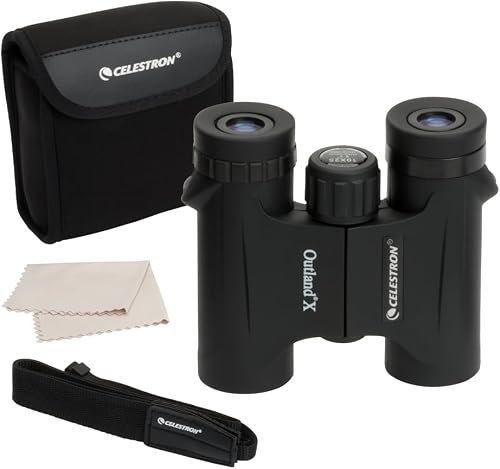
1. Celestron Outland X 10×25 Compact Binoculars
Best for: someone who wants one pair for every trail day
A hiker who carries binoculars on most walks wants a pair that handles birds, distant ridgelines and changing weather without a second thought. The Outland X 10×25 answers that with 10x magnification and 25mm objective lenses. The 6.2° angular field of view helps you follow a moving bird without swinging the whole binocular around. That wider view matters more than it sounds — at 10x, a narrow field makes fast subjects hard to catch.
The build is rubber-armored polycarbonate, and the listing says it’s waterproof and nitrogen-purged against fogging in rain, snow or humidity. Multi-coated lenses and BaK-4 prisms are listed for bright, color-accurate images. Celestron backs it with a Limited Lifetime US Warranty and US-based tech support, which is the longest cover in this group. This isn’t the pair for someone who wants the smallest, lightest thing in a jacket pocket — the 10×25 body is pocket-friendly, but it’s a full trail binocular, not a mini.
Good if:
- You hike often and want one pair that covers birds, wildlife and landscapes
- You want a long warranty and US support behind the purchase
- You’ll be out in rain or humidity and want fogging protection
Skip it if:
- You want the smallest possible pair and pack space is tight
- You’d rather have lower magnification for steadier handheld viewing
2. Nikon Trailblazer 8x25mm ATB Binoculars

Best for: someone who hikes in wet, cold or changeable weather
Weather is the whole point here. The Trailblazer 8×25 ATB is nitrogen-filled and O-ring sealed for full waterproof and fogproof protection, per the listing. That’s the same claim the Celestron makes, so the real difference is elsewhere: 8x magnification against 10x. Lower power is easier to hold steady by hand, which suits long scanning sessions more than quick looks. Fully multicoated lenses are listed for bright, high-contrast images even in low light.
The body is rubber-armored with a foldable roof prism design, and the listing describes a slip-resistant hold in wet or gloved hands. It comes as a kit — travel case, strap and lens covers included, so nothing extra is needed to start. The trade-off is reach: 8x shows less detail at long distance than a 10x pair, so this isn’t the pick for someone who mostly watches far-off ridgelines.
Good if:
- You hike in rain, humidity or sharp temperature shifts
- You want a steady handheld view for long scanning
- You want a case, strap and lens covers in the box
Skip it if:
- You mostly watch distant wildlife and want more reach
- You want the smallest, lightest option for a daypack
3. POLDR 8×21 Small Compact Binoculars

Best for: someone counting every ounce in the pack
If the binoculars only come out a few times on a walk, weight and size decide it. The POLDR 8×21 is built as a mini pocket pair — the listing says you can throw them in a backpack daily without hesitation. The 8×21 optics give 8x magnification with 21mm objective lenses and a 369ft/1000-yard field of view. A wide view is genuinely useful for finding a bird fast, though 21mm lenses gather less light than 25mm ones.
Focus works through a smooth center-focus knob plus a right-eye lens adjustment, and the folding body suits adults and kids. The prism is BaK-4 and the body is magnesium. The listing includes a neck strap, cleaning cloth and carrying bag. This isn’t the pair for low-light dawn or dusk viewing, or for anyone who wants serious reach — it’s the light pack option.
Good if:
- You want the smallest, lightest pair to carry every day
- You want a wide field of view for spotting subjects quickly
- You want a pair that adults and kids can both use
Skip it if:
- You often watch at dawn or dusk and need more light gathering
- You want strong magnification for distant subjects
4. Bushnell Powerview 10×25 Compact Binoculars

Best for: a first-time buyer who wants it simple
Some buyers just want a compact 10×25 pair from a known brand and don’t want to study specifications. That’s who the Powerview 10×25 suits. The listing gives the name and the size — 10x magnification, 25mm lenses — and nothing more. So there’s no stated waterproofing, no stated prism type, and no stated warranty to weigh here. If those details matter to you, the Celestron and Nikon listings state them and this one doesn’t.
What you can say is that 10×25 is the same size class as the Outland X, so the magnification and lens diameter are in the same territory. Beyond that, judge it on what the seller chose to publish. This isn’t the pick for a hiker who needs a documented weather-sealed body or a stated warranty term.
Good if:
- You want a compact 10×25 pair and don’t need detailed specs
- You recognize the Bushnell name and want a simple choice
- You’ll use them in fair weather on easy trails
Skip it if:
- You need stated waterproof and fogproof protection
- You want a stated warranty term before buying
5. Occer 12×25 Compact Binoculars

Best for: someone who wants the most reach in a small body
More magnification means more detail at distance, and the Occer 12×25 lists 12x — the highest here — with 25mm objective lenses and a 273ft/1000-yard field of view. The listing pairs that with FMC broadband coating and a BaK-4 prism for image quality. It also lists pull-down rubber eyecups and long eye relief, so glasses wearers can keep their glasses on and still get a comfortable view. The eyepieces are listed at 15mm.
Two things to weigh. First, 12x is the hardest power to hold steady by hand, so a distant bird can shimmer. Second, the listing calls it life waterproof, not fully waterproof, and the body is ABS plastic with rubber armor. It isn’t the pick for a hiker who wants a fully sealed body for wet weather.
Good if:
- You want the strongest magnification in a compact pair
- You wear glasses and want pull-down eyecups with long eye relief
- You want a single set that the whole family can share.
Skip it if:
- You hike in heavy rain and need full waterproofing
- You struggle to hold high magnification steady by hand
Where These Overlap
The Celestron Outland X 10×25 and the Nikon Trailblazer 8×25 ATB are both rubber-armored and listed as waterproof and fogproof, though the listing doesn’t mention the prism type for the Nikon. The real separator is magnification — 10x against 8x — and the Celestron adds a stated lifetime warranty. The POLDR 8×21 and the Occer 12×25 sit at opposite ends: one is the lightest and widest view, the other the strongest and hardest to hold steady. The Bushnell Powerview 10×25 stands apart only because its listing publishes so little to compare.
Still Not Sure?
How often will I really use them on a hike?
Be honest about this one. If they’ll come out on most walks, the Celestron Outland X 10×25 earns its place with 10x reach and a stated lifetime warranty. If they’ll mostly stay in the pack, the POLDR 8×21 is the lighter thing to carry.
I wear glasses — which pair works with them?
Look for stated eye relief and adjustable eyecups. The Occer 12×25 lists pull-down rubber eyecups and long eye relief for glasses wearers, which is the clearest match here. The Nikon Trailblazer 8×25 ATB is the other one to check against your frames.
What am I most likely to regret?
Usually the magnification. A 12x pair like the Occer 12×25 shows more detail but is harder to hold steady by hand, and a 21mm pair like the POLDR 8×21 gathers less light at dawn. The Nikon Trailblazer 8×25 ATB sits in the middle on both counts.
Frequently Asked Questions
What magnification is best for hiking binoculars?
It’s a trade-off. Higher power shows more detail but shakes more in your hands. The Celestron Outland X 10×25 and Bushnell Powerview 10×25 use 10x, the Nikon Trailblazer 8×25 ATB and POLDR 8×21 use 8x, and the Occer 12×25 goes to 12x.
Are 8×21 or 8×25 binoculars too small for hiking?
No — small is the point on a trail. The POLDR 8×21 is built as a mini pocket pair with a 369ft/1000-yard field of view. The Nikon Trailblazer 8×25 ATB is a step up in lens size and adds stated waterproof and fogproof sealing.
Do I need waterproof binoculars for hiking?
Only if you’ll be out in rain, snow or heavy humidity. The Celestron Outland X 10×25 and Nikon Trailblazer 8×25 ATB both list waterproof, nitrogen-purged or nitrogen-filled bodies. The Occer 12×25 lists life waterproof only, and the Bushnell Powerview 10×25 states no weather sealing.
How do I focus compact binoculars?
Most compact pairs use a central focus knob plus a right-eye adjustment. The POLDR 8×21 and Occer 12×25 both describe a smooth center-focus knob with a right-eye lens dial. Set the right eye first, then use the center knob for distance. The Celestron support pages cover focus and setup for their optics.
Conclusion
Two situations split most buyers. If you hike often and want reach plus a stated lifetime warranty, look at the Celestron Outland X 10×25. If pack weight decides everything, the POLDR 8×21 is the one to check. Pick your situation, then tap through to see the product details on Amazon.