As an Amazon Associate, we earn from qualifying purchases. This post contains affiliate links – if you buy through them, we may earn a commission at no extra cost to you.
There’s no single best boot for ice fishing. The right one depends on three things: how cold your lake gets, how far you walk to your spot, and how much you hate pulling boots on and off with gloves. The Muck Arctic Pro and the Baffin Snow Monster split most buyers, one for all-day waterproof comfort, one for the coldest days on record.
1. Muck Arctic Pro

Best for: someone standing on ice all day in wet slush.
Staying dry matters most, because wet feet end a fishing day. This boot uses 8 mm neoprene with a rubber shell, and the listing calls it 100% waterproof at a 17-inch height. That height covers deep slush and the splash zone.
It’s comfort rated from -60 °F to 30 °F, with fleece lining and 2 mm thermal foam under the footbed. A stretch-fit topline seals the calf, so snow and debris stay out. The trade-off is weight and bulk — it isn’t a walking boot, and the outsole is built for mud and rough ground.
Good if:
- You fish in wet, slushy conditions and need full waterproofing
- You stand still for hours and want maximum insulation
- You want a tall boot that seals at the calf
Skip it if:
- You want something light for short trips
- You prefer a boot with built-in ice traction
2. Muck Arctic Sport Tall

Best for: a first-time buyer who wants a tall, warm, simple boot.
The listing here is short, and that matters. It describes a tall boot with a soft, insulating lining built for warmth. That’s the whole pitch — no temperature rating or waterproof claim.
So the honest read is this: if you want the tall insulated Muck shape without the extreme-cold rating of the Arctic Pro, this is the simpler option. If you need a specific cold-weather number to compare against, this listing doesn’t give you one, and that’s a real gap when you’re choosing between three Mucks.
Good if:
- You want a tall insulated boot and don’t need a temperature rating
- You like a soft lining against your leg
- You’re replacing a worn-out pair and want the same style
Skip it if:
- You need a stated cold-weather rating to decide
- You fish in standing water and want waterproofing spelled out
3. Muck Arctic Ice Mid

Best for: someone walking on bare, wet ice who fears a fall.
Grip is the whole story with this boot. The listing names Vibram Arctic Grip A.T for wet ice traction, paired with XS Trek Evo. That’s the most specific traction claim in this group.
It’s a mid-height boot with an 8 mm neoprene bootie, extended rubber coverage, fleece lining and a 100% waterproof claim.
Good if:
- You walk on wet, bare ice and want the best stated grip
- You want a mid-height boot for easier movement
- You want waterproofing and a fleece lining together
Skip it if:
- You cross deep slush and need tall coverage
- You want a boot you can roll down or wear two ways
4. Kamik Tundra

Best for: the angler who walks to the spot and fishes hard.
Baffin built this one for movement. The removable multi-layer liner includes Thermaplush, B-Tek Heat, a heat-reflecting membrane and Hydromax moisture control.
The upper is tall nylon with a locking snow collar, reflective piping, a Velcro ankle strap and a pull loop. Underneath sits an Arctic Rubber shell, an EVA midsole and a Polar Rubber outsole.
Good if:
- You walk or snowshoe to your fishing spot
- You want a removable liner you can dry separately
- You want reflective piping for low light
Skip it if:
- You sit still all day in extreme cold
- You want a boot with built-in cleats
5. Baffin Snow Monster

Best for: the coldest days, where warmth outranks everything.
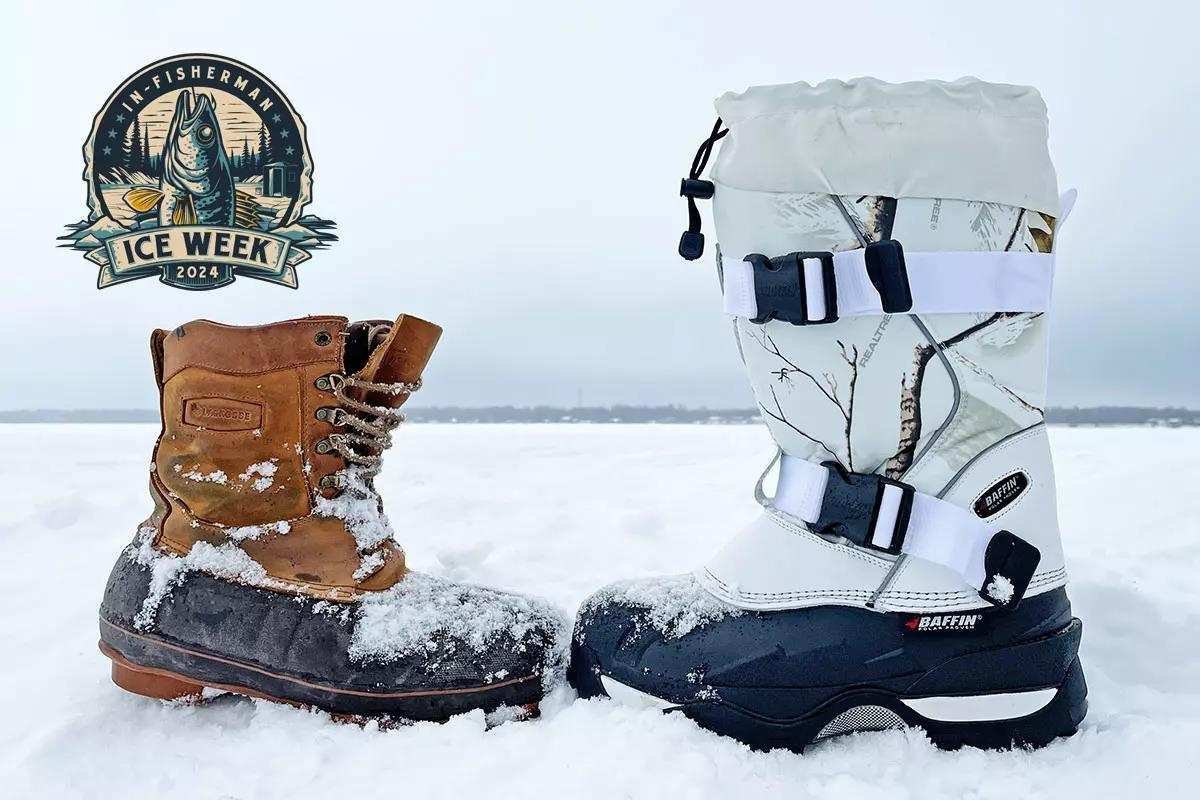
This is the warmest rating in the group: -22 °F to -49 °F, Arctic rated and proven on expeditions to Baffin Island. The upper is full grain insulated leather with a nylon locking snow collar, seam-sealed, with a gaiter clip at the vamp and a pull loop at the back.
The base pairs a Polar Rubber outsole with an Arctic Rubber shell, an EVA midsole and Icepaw pads. Inside, there’s a long list of layers — Thermaplush, B-Tek Foam, B-Tek Heat hollow-fiber insulation, a heat-reflecting membrane, PolyWool, Hydromax and Diamond Net — plus a waffle-comb footbed.
Good if:
- You fish in extreme cold, well below zero
- You want leather in the upper, not just rubber
- You want the highest stated cold rating here
Skip it if:
- Your winters are mild and you run warm
- You want a light boot for long walks
6. Baffin Wolf

Best for: mixed winter use, from ice fishing to hunting.
The Wolf is the generalist. Baffin lists it for hunting, ice fishing and powersports, at moderate to high activity, and rates it Tundra Rated for frozen terrain. The insulation is a Comfort-Fit removable multi-layer inner boot with Thermaplush, B-Tek Foam, B-Tek Heat, a heat-reflecting membrane and Diamond Net.
Good if:
- You want one boot for fishing, hunting and chores
- You like buckle fastening over straps
- You want a removable liner you can dry
Skip it if:
- You need a stated temperature range to choose
- You want a boot with built-in ice cleats
7. Forester Insulated Rubber

Best for: wet, muddy banks and mixed winter work.
Kamik keeps this one simple. It’s a waterproof rubber boot with an 8 mm removable liner, a nylon collar with a drawstring closure, and a slip-resistant explorer outsole.
The listing doesn’t mention a temperature rating.
Good if:
- You fish in wet snow and mud near freezing
- You want a removable liner for drying
- You want a rubber boot for chores too
Skip it if:
- You fish in extreme cold
- You want built-in ice traction
8. Hunting Boots for Men with 1600g Insulation

Best for: a first ice-fishing boot on a tight budget.
Hunthor packs a lot into the description. It lists 1600 g of insulation with a dual-layer lining of 4 mm neoprene and 2 mm fleece, rated to -20 °F, with a fully waterproof upper. There’s reinforced rubber at the toe and heel, an adjustable back gusset, a kick-off heel plate and a steel shank.
Good if:
- You want heavy insulation without a premium build
- You hunt and fish with the same pair
- You want a kick-off plate for easy removal
Skip it if:
- You walk on bare, wet ice and need specialized grip
- You want a plain color rather than camo
9. Klondike 2
Best for: anyone who wants cleats built into the boot.
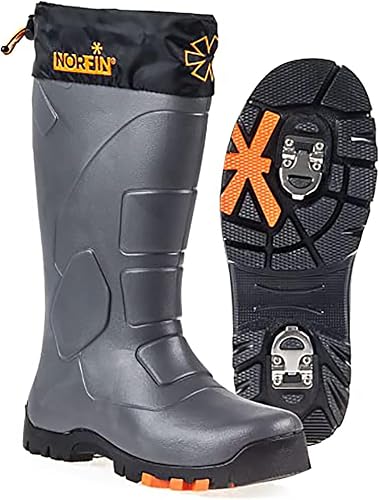
Norfin solved the ice problem differently. The rubber outsole has two retractable cleats you can deploy for grip and retract indoors.
Good if:
- You want cleats without a separate pair to carry
- You fish in extreme cold and want a -40 °F rating
- You want a removable insole for drying
Skip it if:
- You want aggressive tread across the whole sole
- You want a tall boot with a sealed collar
10. Easy On Ice Boot

Best for: someone who wants to roll a boot down and vent.
Striker built this one around two ideas: less bulk, and easier on and off.
The standout feature is the roll-down design. You can roll it halfway to vent your feet, or pull it up to keep heat in.
Good if:
- You want to vent your feet without taking boots off
- You want a lighter boot with a pull tab
- You fish, snowmobile or hike in the same pair
Skip it if:
- You need maximum insulation for extreme cold
- You want built-in cleats or a sealed tall collar
Where These Overlap
The two Baffin boots with removable liners — the Tundra and the Wolf — are close enough that the choice barely matters. The Tundra states a temperature range and an activity level; the Wolf doesn’t.
The Muck Arctic Pro and the Baffin Snow Monster look similar on paper but aren’t.
Still Not Sure?
How cold does it actually get where I fish?
Be honest about your worst day, not your average one. If you regularly see below zero, the Baffin Snow Monster is rated for it. If you fish closer to freezing and fight slush, the Muck Arctic Pro handles wet better.
Do I need built-in ice cleats, or will tread do?
It depends on what you walk on. The Muck Arctic Ice Mid names Vibram Arctic Grip for exactly that, and the Klondike 2 has retractable cleats.
What will I regret most about my pick?
Usually the wrong insulation weight for how much you move. A boot built for standing still, like the Muck Arctic Pro, keeps you warm on a bucket. Match the boot to your habit.
Related guides
- Is Fireline Good for Ice Fishing ?
- Does Chumming Work for Ice Fishing?
- Can You Use Crickets for Ice Fishing?
Frequently Asked Questions
Are rubber boots or leather boots better for ice fishing?
It depends on your conditions. Rubber and neoprene, like the Muck Arctic Pro, handle standing water and slush because the shell is waterproof. Leather, like the Baffin Snow Monster, is seam-sealed and warmer-rated. Wet slush favors rubber; deep dry cold favors leather.
What temperature rating do ice fishing boots need?
It depends on how still you are. Baffin rates the Snow Monster from -22 °F to -49 °F, and the Tundra from 14 °F to -22 °F for higher activity. If you sit on a bucket in deep cold, aim for the lower range. If you walk, a higher-activity boot works.
Can I wear ice cleats with insulated winter boots?
Yes, and some boots build them in. The Norfin Klondike 2 has two retractable cleats in the outsole. The Baffin Snow Monster uses Icepaw pads for contact-point grip. If you use separate cleats, check they fit over your boot’s height and sole shape first.
How should I dry insulated ice fishing boots?
Pull the liner or insole out and dry it separately. Norfin’s care instructions say to air-dry insoles and liners away from direct heat after every wet use.
Conclusion
If you fish wet slush and stand still, the Muck Arctic Pro is your boot. If you fish the deepest cold and want the highest rating here, take the Baffin Snow Monster. Next step: check sizing on the one that matches your worst day, not your average one.