
As an Amazon Associate, we earn from qualifying purchases. This post contains affiliate links – if you buy through them, we may earn a commission at no extra cost to you.
There isn’t one single best compass for hiking that fits every person who walks a trail. The right pick depends on where you hike, how far you go off marked paths, and what tools you already carry. These five products differ in how they handle low light, whether they work across hemispheres, and what extras they build into the baseplate. Some include mirrors for sighting distant landmarks, while others keep things minimal so a new hiker doesn’t get lost in features. If you need serious backcountry precision, the Suunto MC-2 Compass is built for it. If you want something simple that just points north without fuss, the Suunto A-10 does exactly that.
1. Suunto MC-2 Compass

Best for: Serious hikers navigating complex terrain across different global regions.
This mirror compass was made with serious hikers in mind, aiming for precise directional measurement wherever you are. It’s balanced for global use, meaning the needle won’t drag or stick when you cross hemispheres. The listing doesn’t mention the consequences of using a northern-balanced compass in the southern hemisphere. It includes Metric UTM scales and an inch ruler directly on the baseplate.
You can operate it in low light conditions thanks to its specific design choices. The sighting hole and notch let you take accurate bearings over long distances. It also packs a declination adjustment tool and a clinometer for measuring slopes. Made in Finland by a company founded in 1936, it requires no batteries to function.
Good if:
- You hike internationally and cross between hemispheres often.
- You need to measure slope angles while trekking mountains.
- You want professional-grade navigation without relying on electronics.
Skip it if:
- You only walk short, well-marked trails near home.
- You’re a first-time buyer who might find multiple scales confusing.
2. Silva Ranger 2.0 Compass

Best for: Hikers needing reliable grip and precise map reading on wet trails.
A compass slips easily when your hands are wet or cold, but this one has a DryFlex rubber grip for easy handling. That grip changes how confidently you take readings during bad weather. It includes a built-in adjuster for magnetic declination based on your location. You don’t have to do mental math to correct for true north.
Mirror sighting with a sighting hole helps determine direction over long distances. It also comes with a slope card for measuring inclines and calculating extra distance. A magnifying lens sits right on the baseplate for precision map work. These features make it a strong tool for anyone reading detailed topographic maps.
Good if:
- Your hands get cold or sweaty on long hikes.
- You read detailed topographic maps frequently.
- You need to calculate slope distances accurately.
Skip it if:
- You hike exclusively in dry, warm climates where grip matters less.
- You prefer a completely bare-bones, lightweight setup.
3. Cammenga Official US Military Tritium Lensatic Compass

Best for: Hikers operating in extreme temperatures requiring military-grade durability.
Built to US military standards, this olive drab lensatic compass focuses heavily on reliability and precision. It’s shockproof, waterproof, damage resistant, and sand proof. That level of protection means it keeps functioning smoothly whether you drop it on rocks or wade through rivers. It operates across a wide range of -50° F to 150° F.
Instead of paint that fades, it uses 7 tritium micro lights for illumination. These self-powered illuminators provide glow for over 12 years, ensuring accurate readings even in total darkness. You never charge it or expose it to sunlight first. It arrives with a carrying pouch, lanyard, warranty card, instruction booklet, and clam shell case.
Good if:
- You hike in deserts, snow, or harsh environments.
- You navigate at night and can’t rely on external light.
- You want gear that survives drops and water submersion.
Skip it if:
- You primarily use flat baseplate maps for navigation.
- You want a lightweight addition to a fast-packing kit.
4. SUUNTO A-10 Compass
Best for: Beginners wanting a straightforward, reliable tool for local day hikes.
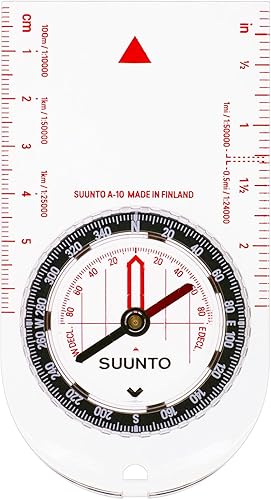
Minimalistic and straightforward, this recreational compass is designed to be fast and simple to use. It strips away complex dials so you can focus purely on finding your direction. It’s balanced specifically for northern hemisphere use. The listing doesn’t mention travel restrictions for the A-10.
The baseplate features inch and centimeter scales along with a fixed declination scale. It uses a high-grade steel needle with a jewel bearing inside a liquid-filled capsule. Like other models from this Finnish brand founded in 1936, it needs no batteries.
Good if:
- You’re learning basic map and compass skills.
- You stay within the northern hemisphere year-round.
- You want a compact tool for quick weekend trips.
Skip it if:
- You plan to hike in Australia or South America.
- You need adjustable declination for highly precise orienteering.
5. Sun Company ProSight Sighting Map Compass with Adjustable Declination

Best for: Map readers needing adjustable declination and bright low-light visibility.
True North and Magnetic North aren’t identical, which throws off many hikers who don’t account for it. This baseplate map compass solves that with an adjustable declination dial for precise direction reading. NOAA explains magnetic declination as the angle between those two norths, changing depending on where you stand. Adjusting for it directly on the dial removes guesswork.
The bezel rotates 360 degrees, and the dial is ultra-luminous for low-light situations. A folding protective cover opens to reveal a full-sized sighting mirror. It also includes a clinometer for measuring landmark heights, plus instructions for setting declination and taking bearings. Other additions are a jewel bearing, 3X magnifying glass, four map scales, rulers, a break-away safety lanyard, and silicone anti-slip foot pads.
Good if:
- You teach kids or scouts basic navigation skills.
- You switch between different map scales often.
- You need clear readings at dawn or dusk.
Skip it if:
- You prefer a smaller footprint in your pocket.
- You dislike unfolding covers before taking a quick bearing.
Where These Overlap
The Suunto MC-2 Compass and Silva Ranger 2.0 share much of the same DNA. Both offer mirror sighting, declination adjustment, and slope measurement. Choosing between them really comes down to whether you prioritize global needle balance or a rubberized grip for wet hands. The Suunto A-10 stands apart entirely, dropping the mirrors and adjustments for pure simplicity. Meanwhile, the Cammenga Tritium Lensatic occupies its own space, trading flat baseplates for military-grade housing and self-powered tritium lighting.
Still Not Sure?
How far off marked trails will I actually go?
If you stay on clear paths, you don’t need complex sighting mirrors or clinometers. A simple tool prevents over-complicating your walk. But if you venture into unmapped backcountry, precision saves you from dangerous mistakes. For marked trails, the Suunto A-10 handles everything you’ll face.
Do I already carry detailed topographic maps?
A compass alone doesn’t guide you; it works alongside your map. If you carry detailed maps with multiple scales, you need a baseplate that matches them. Without maps, advanced features just add confusion. If you read topo maps regularly, choose the Sun Company ProSight.
What happens if my battery dies or the screen breaks?
Electronic devices fail when wet, cold, or dropped. Mechanical navigation avoids that risk entirely, but some designs protect against physical damage better than others. If you worry about drops or extreme weather ruining your gear, the Cammenga Tritium Lensatic is built for that exact fear.
For day hikers sticking to the northern hemisphere, the Suunto A-10 gives you exactly what you need without clutter. For those pushing into rough terrain or crossing borders, the Suunto MC-2 Compass provides the professional features required to stay safe. Pick the one that matches your actual trail habits, then practice with it in a familiar park before heading into the deep woods.
Related guides
- 10 Best Sun Hats for Hiking: Expert Picks for Every Trail this year
- 10 Best Bras for Hiking: Expert Picks for Every Trail Type this year
- 10 Best Sun Gloves for Hiking: Our Top Picks for Every Trail this year
Frequently Asked Questions
Will a northern hemisphere hiking compass work in South America?
No, it likely won’t. The Suunto A-10 is balanced specifically for northern hemisphere use, meaning the needle might drag or tilt south of the equator. If you hike globally, the Suunto MC-2 Compass is balanced for worldwide use and avoids this problem.
How does tritium lighting work in a hiking compass?
Tritium gas glows continuously without needing sunlight or batteries. The Cammenga Tritium Lensatic uses seven micro lights that provide illumination for over twelve years. This lets you take accurate bearings in complete darkness, unlike standard luminous paint that must be charged by light first.
Why does a hiking compass need adjustable declination?
Magnetic north and true north point in slightly different directions depending on your location. Models like the Silva Ranger 2.0 and Sun Company ProSight let you adjust for this difference directly on the dial. Without it, your map bearings could lead you significantly off course over long distances.
What does a clinometer do on a hiking compass?
A clinometer measures the angle of a slope or the height of a landmark. The Suunto MC-2 Compass and Sun Company ProSight both include one built into the dial. This helps hikers assess steep terrain ahead or estimate distances using known object heights.
Conclusion
Choosing your tool is just the beginning of your journey. Once you’ve picked one, head to a local park and practice following a simple bearing until it feels natural. You’ll gain confidence quickly, and you won’t have to worry about your phone battery dying when you’re out exploring the wilderness.