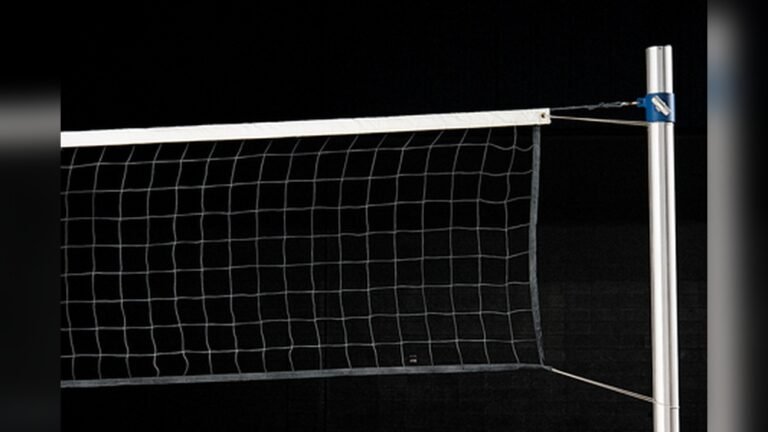
Are you setting up your volleyball game and wondering what the regulation height volleyball net should be? Getting the net height just right is crucial for fair play and a great match.
Whether you’re playing competitively or just for fun, knowing the exact net height can boost your confidence and improve your skills. You’ll discover the official standards, how they vary by age and gender, and tips to ensure your net is perfectly set every time.
Keep reading to make sure your volleyball setup meets the rules and helps you play your best!
Net Height Standards
Volleyball net height is crucial for fair and competitive play. Different groups have specific height standards. These standards ensure the game remains challenging yet enjoyable. Understanding these heights helps players and organizers set up courts correctly.
Men’s Regulation Height
The official height for men’s volleyball nets is 2.43 meters. This equals about 7 feet 11 5/8 inches. This height is used in professional and international men’s competitions. It challenges players to jump higher and improve their skills.
Women’s Regulation Height
Women’s volleyball nets are set lower than men’s. The official height is 2.24 meters. This is around 7 feet 4 1/8 inches. This height suits the average reach and jumping ability of female players. It keeps the game balanced and competitive.
Co-ed And Recreational Heights
Co-ed volleyball often uses a middle ground for net height. The net is usually set at 2.35 meters. This equals about 7 feet 8 inches. Recreational leagues also use this height. It allows both men and women to play together fairly.
Youth Volleyball Net Heights
Youth volleyball nets vary by age group. Younger players use lower nets to match their abilities. For example, nets for kids under 12 may be as low as 1.8 meters. This helps young players develop skills and enjoy the game. Heights increase as players grow older.
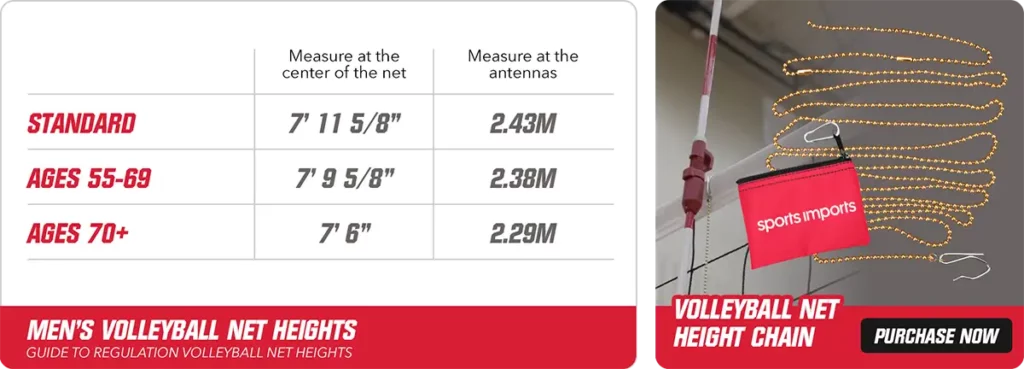
Credit: www.sportsimports.com
Measurement Details
The measurement details of a regulation height volleyball net are crucial for fair play. Precise net height ensures the game follows official rules. Each level of play has specific standards to maintain consistency.
Understanding how to measure the net and allowable height variations helps players and officials set up correctly. Measurements use both metric and imperial units to accommodate different regions.
Measuring The Net Center
Measure the net height at the center point between the two poles. This spot must be the reference for official height checks. Use a tape measure from the ground to the top edge of the net.
Ensure the tape is straight and perpendicular to the ground. Avoid measuring at the sides where the net may sag. The center provides the most accurate height reading.
Allowable Side Height Variations
The net height at the sides can vary slightly due to tension. Official rules allow small differences, typically a few centimeters or inches. This prevents penalties for minor sagging or tightness.
Check that side heights do not drop too low compared to the center. Proper net tension keeps the height within allowed limits. Maintaining this ensures fair and consistent play.
Metric And Imperial Units
Volleyball net heights are set in meters and feet to serve global players. The official men’s net height is 2.43 meters or 7 feet 11 5/8 inches. The women’s net height is 2.24 meters or 7 feet 4 1/8 inches.
Some leagues may use mixed units depending on location. Always confirm the unit system before measuring. Using correct units avoids confusion and helps meet official standards.
Court Dimensions And Setup
Understanding the court dimensions and proper setup is essential for playing volleyball correctly. The court size, net placement, and boundary markings all affect the flow of the game. Setting up the court to official standards ensures fair play and consistency. Let’s explore these key elements in detail.
Official Court Size
The standard volleyball court measures 18 meters long and 9 meters wide. It is divided into two equal halves by the net. Each side measures 9 meters by 9 meters. This size applies to both indoor and outdoor volleyball games. The court surface must be flat and clear of obstacles.
Net Placement And Support
The volleyball net is placed at the center of the court, stretching from one side line to the other. It must be taut and supported by two sturdy poles. The official net height is 2.43 meters for men and 2.24 meters for women. Co-ed or recreational games may use a height of 2.35 meters. Proper tension keeps the net stable during play.
Boundary Lines And Markings
Boundary lines mark the playable area on the court. The lines are 5 centimeters wide and clearly visible. The end lines run parallel to the net, defining the court’s length. Side lines run perpendicular to the net, marking the court’s width. Attack lines are drawn 3 meters from the net on each side. These lines guide player positions and actions.
Adjusting Net Height
Adjusting the volleyball net height is essential for fair and fun play. Different players need different net heights. Changing the height helps match the players’ skills and ages. It also supports various types of games, from official matches to casual play.
Using Adjustable Net Systems
Adjustable net systems make changing net height quick and easy. Most systems have simple levers or pins to move the net up or down. This flexibility helps coaches and players set the perfect height fast. It also keeps the net stable during play, preventing unwanted shifts.
Adapting For Different Age Groups
Youth players need lower nets than adults. For example, children under 12 usually play with nets set lower than the official height. Adjusting the net height helps young players learn skills comfortably. This adaptation makes the game more enjoyable and safe for all ages.
Setting Up For Recreational Play
Recreational games often use a net height between official men’s and women’s standards. This middle height suits mixed groups and casual players. Setting the net this way keeps the game balanced and fun. It also encourages more people to join and stay active.
Common Net Types
Volleyball nets come in various types suited for different playing environments and needs. Choosing the right net affects gameplay and durability. Understanding common net types helps players and organizers select the best option. This section explains the main categories of volleyball nets.
Indoor Vs Outdoor Nets
Indoor nets are made for controlled environments. They use lighter materials and finer mesh. These nets resist wear from indoor lighting and air conditions. Outdoor nets are tougher and weather-resistant. They withstand sun, rain, and wind. Outdoor nets have stronger cords and thicker mesh to last longer outside.
Professional Net Systems
Professional nets meet official volleyball standards. They have precise height and tension controls. These nets include durable posts and anchoring systems. They ensure stable play during competitions. High-quality materials prevent sagging and damage. Professional systems often come with easy setup features.
Specialty Nets (sitting Volleyball)
Sitting volleyball nets are lower than standard nets. They allow players to compete while seated. These nets follow specific height rules for sitting volleyball. The design focuses on safety and accessibility. Specialty nets help promote inclusive sports and adapted competitions.
Tips For Perfect Setup
Setting up a regulation height volleyball net correctly is essential for fair play and safety. A proper setup ensures the net stays firm and at the right height throughout the game. Follow these tips to achieve a perfect setup every time.
Ensuring Tension And Stability
Start by tightening the net evenly on both sides. Use the tension straps or cables to avoid sagging. Check the poles are firmly anchored in the ground or base. Stability prevents the net from moving during play. Recheck tension before each game to keep the net firm.
Maintaining Correct Height Over Time
Measure the net height with a tape measure or a standard net height gauge. The official height is 2.43 meters (7 feet 11 5/8 inches) for men and 2.24 meters (7 feet 4 1/8 inches) for women. Mark the poles to help reset the height easily. Inspect the net regularly to adjust for any drop caused by use or weather.
Safety Considerations
Ensure the net cables or straps do not pose tripping hazards. Use padding on poles to protect players from injury. Check that all equipment is in good condition with no sharp edges. Clear the area around the net of any obstacles. Safety helps players focus on the game without risks.
Local Regulations And Variations
Volleyball net height is not always the same everywhere. Local rules and variations affect the regulation height. Different leagues and regions set their own standards. Event organizers sometimes adjust net height to fit their needs. Understanding these differences helps players and coaches prepare better.
League-specific Rules
Each league may have its own volleyball net height rules. Men’s and women’s leagues often use different heights. Youth leagues use lower nets for younger players. Some recreational leagues set a middle height for co-ed play. Knowing your league’s rules avoids confusion during matches.
Regional Differences
Regions may adopt unique net height standards. Some areas follow international rules strictly. Others modify heights based on player skill or tradition. Weather and playing conditions sometimes influence net height choices. Regional differences reflect local volleyball culture and preferences.
Customizing For Event Needs
Event organizers change net height for special tournaments. Charity or fun matches might use non-standard heights. Training camps may adjust heights for skill development. Custom heights help include all players comfortably. Flexibility in net height keeps the game enjoyable for everyone.
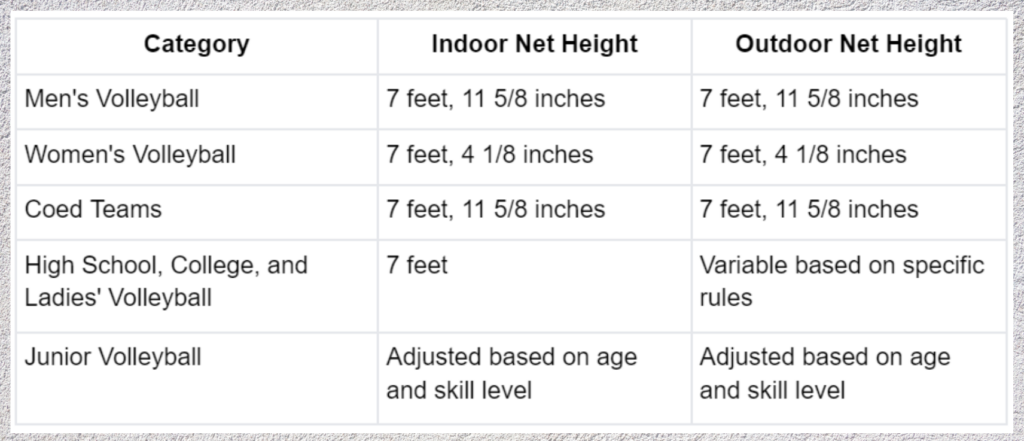
Credit: sterlingvolleyball.com

Credit: www.networldsports.com
Frequently Asked Questions
What Is The Regulation Volleyball Net Height?
The official volleyball net height is 2. 43 meters (7 feet 11 5/8 inches) for men and 2. 24 meters (7 feet 4 1/8 inches) for women. Recreational and co-ed nets usually stand at 2. 35 meters. Youth nets vary by age group and league rules.
Is The Volleyball Net 3 Feet High?
No, a regulation volleyball net is not 3 feet high. It measures 7 feet 11 5/8 inches for men and 7 feet 4 1/8 inches for women. Youth and recreational nets vary but do not typically measure as low as 3 feet.
At What Height Should The Volleyball Net Be Supported?
The volleyball net height should be 2. 43 meters (7 feet 11 5/8 inches) for men and 2. 24 meters (7 feet 4 1/8 inches) for women. Co-ed and recreational nets usually stand at 2. 35 meters (7 feet 8 inches).
Youth nets vary by age group.
How Tall Are 7th Grade Volleyball Nets?
7th grade volleyball nets typically stand 7 feet 4 inches (2. 24 meters) tall, matching the standard girls’ net height. This height suits middle school players and promotes proper gameplay skills.
Conclusion
Understanding regulation height volleyball nets helps improve your game and fairness. Men’s nets stand at 2. 43 meters, while women’s nets are 2. 24 meters tall. Co-ed and recreational nets often set at 2. 35 meters for balance. Youth leagues use lower nets suited to players’ ages.
Always check your league’s rules before setting up the net. Correct net height ensures better play and enjoyment for everyone. Keep these standards in mind when organizing games or practices. This way, volleyball stays fun, safe, and fair for all players.